


Chapter 10: The Cover-Up
How They Pinned the Crime on Scapegoats
Recently, an aficionado of Fox “News” called into my radio program to say that he was “sick and tired of being ripped off by these Somali [Black] welfare cheats.”
I asked him if he realized that from an average taxpayer’s point of view, the amount of federal tax dollars that goes to everyday safety-net programs like SNAP or basic welfare “is about $324 per taxpayer, but direct subsidies and special tax breaks that favor big businesses and industries cost each taxpayer thousands of dollars per year.”
He grunted, as if he didn’t believe me, and hung up the phone. These guys are truly well indoctrinated, which raises the question: how and why did that happen?
Reagan and the oligarchs who funded him were faced with a problem of growing discontent among “the rabble.”
The billionaires and giant corporations had largely accomplished their initial goals by the end of Reagan’s first term, and by Trump’s second, had almost completely subdued the middle class. They’d crushed unions, slashed their own taxes to almost nothing (both personal and corporate), and shipped millions of good-paying jobs overseas to low-wage countries.
They’d turned healthcare from a nonprofit public good (by law in most states) into a $5 trillion-a-year profit center, and hedge funds, big banks, and foreign investors had transformed single-family housing into a virtual casino where the house—themselves—always won. They’d successfully transferred over fifty trillion dollars from working Americans into their own money bins in fewer than forty years.
As planned, the American Dream was dying before average people’s eyes at the same time the oligarchs had become richer than any kings or emperors or pharaohs in world history. Wages stagnated while productivity—and, thus, profits—soared. Young people couldn’t afford to buy their first homes. Medical debt made a fortune for the industry but bankrupted over a half million families every year. Because of all this, the middle class had shrunk from 66 percent to 43 percent in a mere four decades.
This created the problem for oligarch-owned Republican politicians: the result of all this was that people were justifiably angry—seriously pissed off. It was the kind of anger that, throughout history, has toppled oligarchies, brought down governments, and forced the rewriting of constitutions. America had become a boiling pot, and the oligarchs were starting to feel the heat.
So, they did what oligarchs have always done from the days of the Caesars to the Confederacy: they deflected that anger.
Not toward themselves, of course, even though they were the ones actually responsible for the theft of the American Dream. Not toward the corporations that were using ill-gotten constitutional rights to crush workers and capture control of most of our government. And not toward the billionaires whose assets exploded while everyone else’s shrank.
Instead, they deflected the working class’s anger downward, toward the very, very convenient people at the bottom of the ladder, the people with even less power than the tens of millions of struggling workers.
It was a massive cover-up of the theft of human rights, a very specific plan for blaming the victims instead of the perpetrators.
Republicans created, in other words, scapegoats.
Turning Poverty into a Moral Failure
The first move in the corporate oligarchs’ cover-up playbook was to use their political platforms and captured media to make poverty shameful and government help something that everybody should become suspicious of.
Reagan didn’t invent racism or disdain for the poor, of course, but he weaponized both with a fictional character: the “welfare queen.” In speech after speech all across the country and in TV appearances, the Gipper described a woman in Chicago who supposedly had “eighty names, thirty addresses, twelve Social Security cards,” and collected “over $150,000” every year in government benefits. She drove a “big” Cadillac, then a status symbol in the Black community. She was, Reagan told us, living large off us sucker average working-class taxpayers.
The story was almost entirely fabricated. But for Reagan’s purposes, it didn’t need to be true: it only needed to be useful. “Fraud” became the GOP’s favorite word for everything from suppressing the vote to cutting benefits to blaming the death of the middle class on poor and Black people.
And it was devastatingly useful. That single story, told over and over again for eight years, transformed America’s social safety net—so carefully constructed from the New Deal to the Great Society that had lifted millions out of poverty—from a source of security for struggling families into a “scam” that “cheaters” exploited. This victim blaming made poverty a character flaw rather than a product of the GOP’s new system of low wages, union busting, expensive college, unpredictable medical costs, and soaring housing prices.
The “personal responsibility” narrative followed this vilification of poor people as naturally as leaves sprouting in the spring. If poverty was a moral failure, if struggling families were in the straits they found themselves because of “bad choices,” then, Republicans and their conservative media told us, cutting programs that help them isn’t cruelty, it’s tough love. It’s actually doing them a favor by incentivizing better behavior.
I remember how Rush Limbaugh used to tell this joke (one of his favorites when he wasn’t blaming women for the economic problems of white men): “What do you do for a man when he’s down? You kick him! Otherwise, he won’t get up! Hahahaha!”
Notice what this narrative doesn’t mention: stagnant wages, union busting, exploding healthcare and education costs, skyrocketing housing prices, offshored jobs, or any of the actual causes of economic insecurity brought to us by the Reagan Revolution, powered by corporate constitutional rights based on Davis’s headnote. It instead keeps working-class anger focused on other working-class people—the ones getting “handouts”—while the oligarchs quietly pocket another trillion dollars.
It was the old story of the fat-cat corporate CEO sitting at a table with two working men, each with a plate before him. The CEO has a huge pile of cookies, and each of the two workers has a single cookie on his plate. The CEO points to one of them and says to the other, “Look out, he wants your cookie!”
The Southern Strategy and “Law and Order”
That well-known cookie meme also has a variation, where one worker is Black and the other is white. The CEO points at the Black worker and tells the white worker the Black guy wants to steal his cookie.
Reagan’s welfare queen imagery wasn’t racially neutral by a long shot. Everyone knew who Reagan was describing, just like when he’d ask people if they got angry when a “young buck” was in front of them in the supermarket line “buying steak with food stamps while all you can afford is hamburger.”
The cover-up and deflection playbook has always had a racial dimension, but after the legal and political successes of the Civil Rights Movement in the 1960s and 1970s, explicit racism became politically toxic.
So Republican strategists developed what Nixon called his Southern Strategy, which Reagan cheerfully adopted in his first speech after his nomination in 1980. It was about “states’ rights” near the scene of the Mississippi Burning murder of three civil rights workers.
It was elegant in its simplicity, a deliberate shift from explicit racism to barely coded language that activated the same resentments while maintaining a veneer of plausible deniability that could be used with great indignation in media appearances when Republicans were accused of playing the race card.
Lee Atwater, the Republican strategist who managed George H.W. Bush’s 1988 campaign and created the infamous Willie Horton ad, explained it with unusual candor in a 1981 interview: “You start out in 1954 by saying, ‘N*****, n*****, n*****.’ By 1968 you can’t say ‘n*****’—that hurts you, backfires. So, you say stuff like, uh, forced busing, states’ rights, and all that stuff, and you’re getting so abstract. Now, you’re talking about cutting taxes, and all these things you’re talking about are totally economic things, and a byproduct of them is, Blacks get hurt worse than whites.”
How This Relates to Today:
In this chapter excerpt we see how the GOP, having basically nothing to offer the average American, has turned to racism and bigotry to fuel their campaigns to get and hold political power.
This strategy, making use of the reality — well known to the Republicans on the Supreme Court — that the vast majority of the morbidly rich are so self-obsessed that they’ll sacrifice our democracy for a tax cut, has been at the core of Republican campaigns since Nixon rolled out his “Law and Order” program to try to disrupt both the anti-war and Civil Rights movements.
Dan Baum chronicled how it works — and why — in 1994 when he interviewed Nixon’s domestic policy chief, John Ehrlichman, about Nixon’s “war on drugs” effort, and Ehrlichman said:
“You want to know what this was really all about? The Nixon campaign in 1968, and the Nixon White House after that, had two enemies: the antiwar left and Black people. You understand what I’m saying?
“We knew we couldn’t make it illegal to be either against the war or Black, but by getting the public to associate the hippies with marijuana and Blacks with heroin, and then criminalizing both heavily, we could disrupt those communities.
”We could arrest their leaders, raid their homes, break up their meetings, and vilify them night after night on the evening news.
“Did we know we were lying about the drugs? Of course we did.”
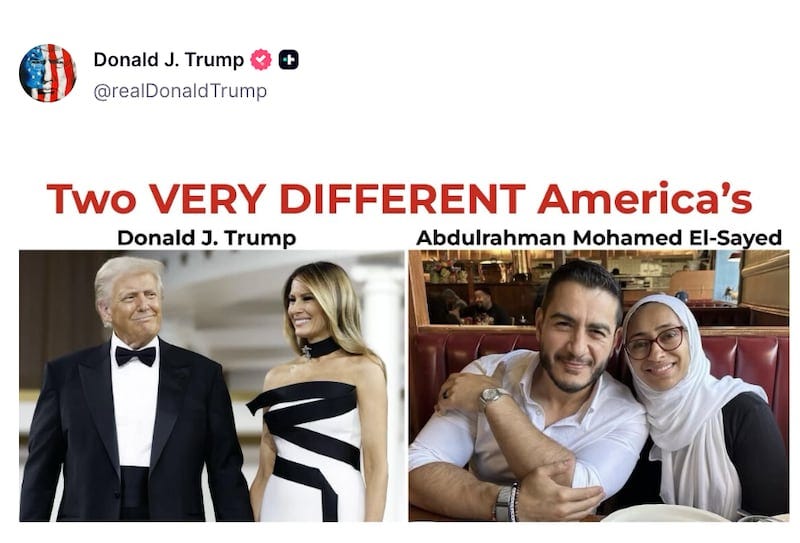
Here’s today’s example, posted last night to Trump’s Nazi-infested social media network. Because they’re entirely devoted to making themselves and their billionaire buddies (13 of them in Trump’s cabinet) richer and screwing working class people to do so, their entire message is: “See his brown skin? See her burka? See how different they are from us white ‘Christian’ people?”
Let’s continue the conversation next week…
Rounding up immigrants and sending them out of the country was supposed to create more jobs for the native born. How did that work out, according to Friday's employment report?
Capitalism couldn't continue without victim-blaming, and the victims believing they are at fault.
On point again Thom...Thanks for your work to bring these matters to light.