

Trump’s and Netanyahu’s insane war against Iran has caused gasoline prices to skyrocket here in the United States. The Financial Times yesterday published an article titled, “‘Pump anxiety’ from soaring fuel prices prompts surge in EV interest.” Even The New York Times has noticed, with Michael Grunwald writing in an article titled Now is the Perfect Time to Buy an Electric Vehicle:
“Even before prices at the pump started soaring above $4 a gallon, Consumer Reports found that the typical E.V. owner saves $6,000 to $12,000 on maintenance and fuel over the car’s lifetime.”
Don’t tell that to the grifters in the White House, though. Just a few days ago, JD Vance (or whatever his name is this week; this is his third name-change) told a group of Republicans, speaking about gas prices in the US:
“[Y]ou’ve got a lot of people all over the world who have focused on a lot of green energy scams, and they’re hurting a lot more than we are.”
Right…
The oil industry, which gave Trump hundreds of millions in support to become president, loves it as their costs have not gone gone up but their profits are through the roof. And Putin is grinning from ear-to-ear as Trump has dropped sanctions on Russian oil exports so Vlad is making billions to fund his terror campaign against Ukraine.
All of this has Americans wondering if now is the time to buy an electric vehicle (EV). And, because Trump killed federal subsidies for EVs, the price of them has fallen, and used ones in particular have come way down; they’re are now easily competitive with internal combustion engine (ICE) cars and light trucks.
So, what does it cost to “fill up” and drive an EV? And how far do they go on a “full tank”?
For several years, Louise and I drove a plug-in Toyota Prius electric hybrid; it would go about 30 miles on a charge, and then kick over to gasoline power. Since I rarely drive more than 30 miles a day here in Portland, in the four years I owned the car I only bought gasoline about 10 times.
Now, we have a Hyundai Ioniq5, pretty much the coolest car I’ve ever owned, that is entirely electric. No oil change, no hundreds of engine and transmission parts to worry about failing or repairing, and no gasoline smell in the garage.
And no need to visit the gas station. It’s range is around 300 miles on a full charge, which is about the industry average for EVs.
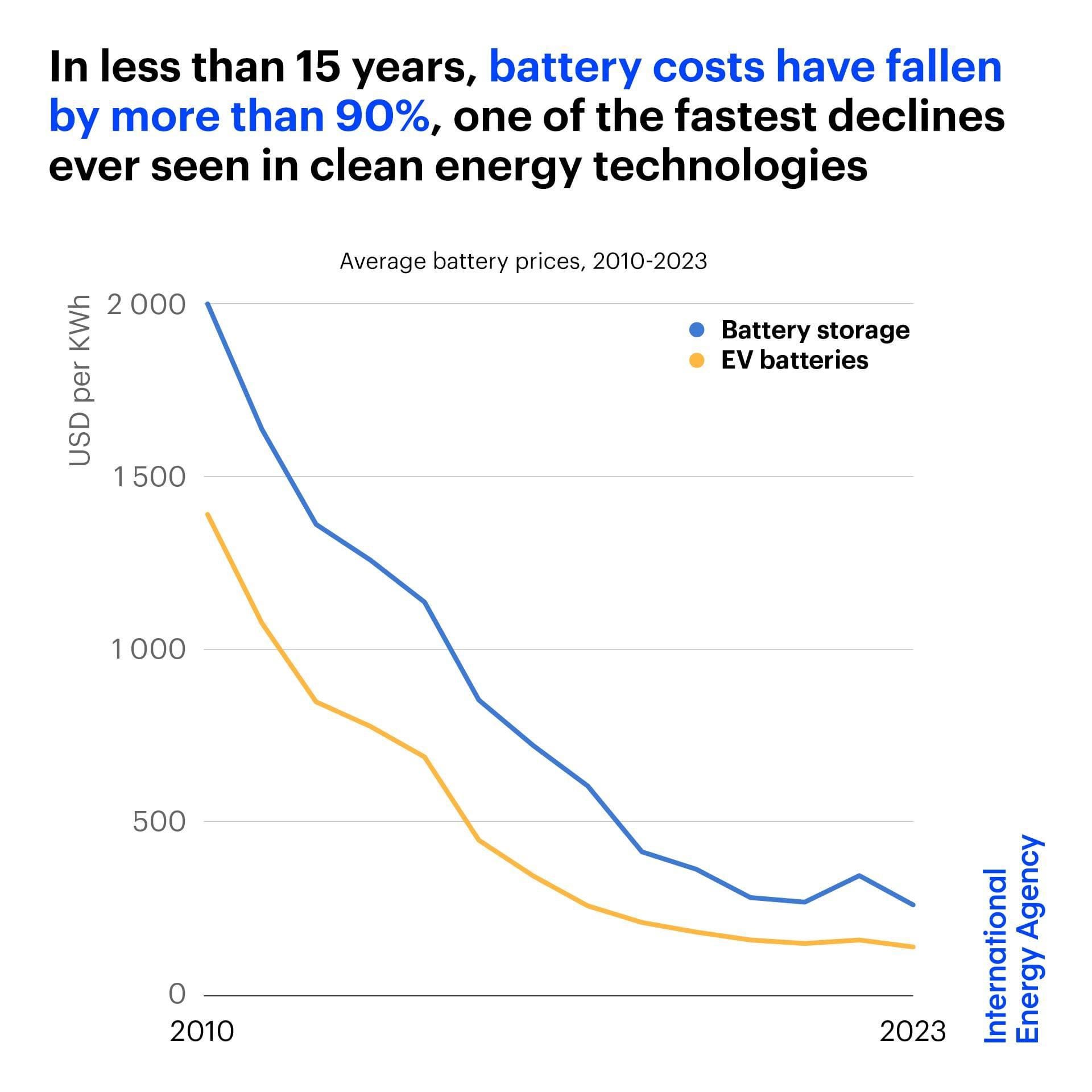
The new car from Arizona carmaker Lucid has an EPA-rated range of 511 miles on a single charge, meaning that we’re now well into the territory where “range anxiety” is a thing of the past. And as battery “energy density” continues to increase while prices fall, 800-1,000 mile ranges for electric vehicles will probably be commonplace within a few years here in the US, and already are available for sale in China.
There are about 70,000 public charging stations in America right now, and they’re being added at the rate about 1,000 a month, even though Trump sabotaged Biden’s plan to install 500,000 additional ones over the next few years.
But, aside from making it easier for people without a garage or home charger to own an EV and just recharge it every few weeks like we buy gas, what does that mean for people considering a new or used EV because of the explosion in gas prices?
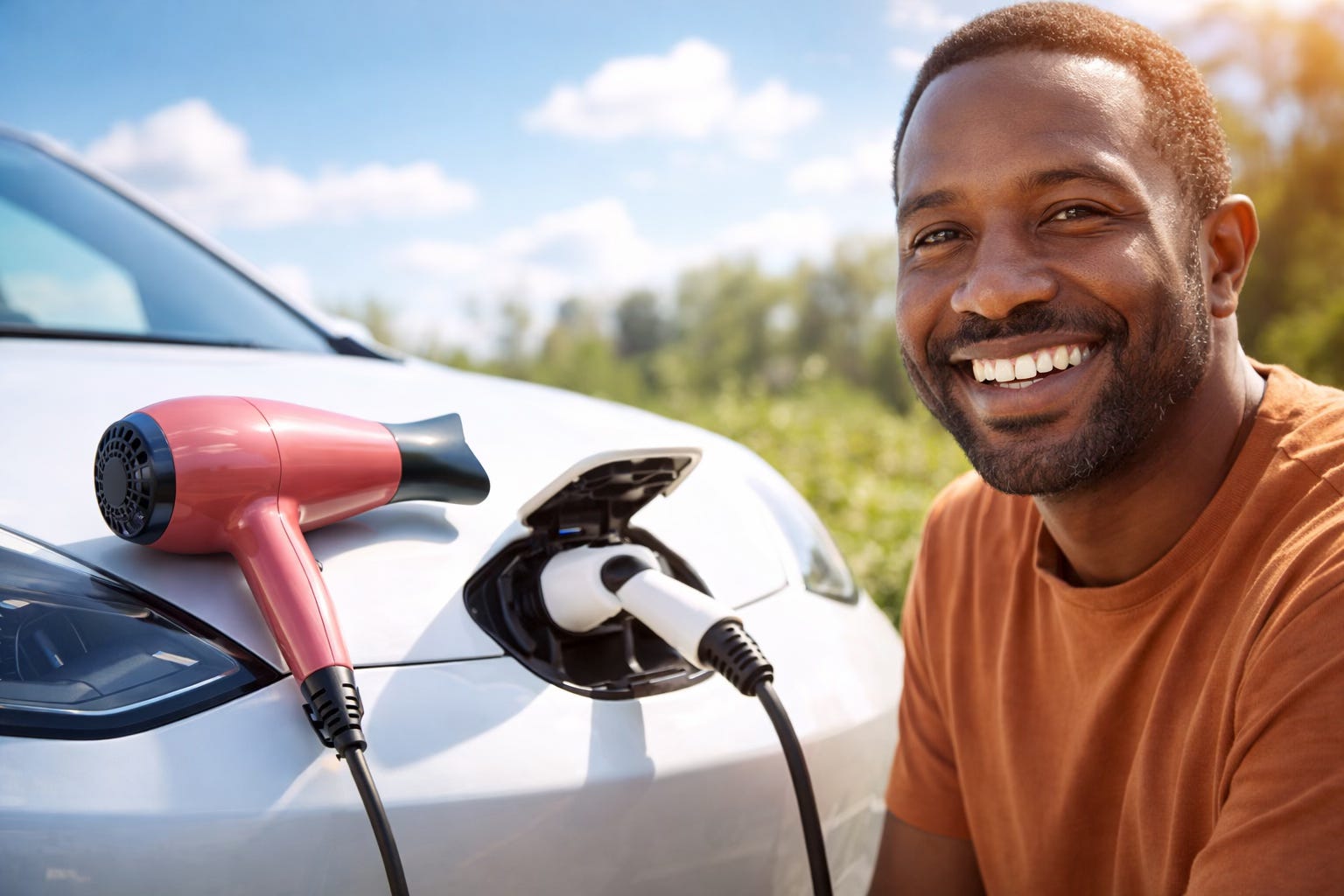
The key to easily understanding both is hairdryers. Seriously.
Most people know that a hairdryer draws about as much power as your average modern outlet will give it — typically around 1000 watts or, at 120 volts, just shy of 10 amps. (Plug in and turn on two hairdryers from the same outlet and you’ll usually blow a circuit breaker: most homes max out at 15 or 20 amps per outlet.)
If those numbers are gibberish to you, hang on: it’ll all have meaning in a moment.
Last year, Donald Trump was trashing electric cars and he went into this rant about how if everybody in America bought an electric car, charging them would take down the entire country’s power grid:
“They want everybody to have an electric car,” he said. “We don’t have enough electricity. We couldn’t make enough electricity for that,”
This assertion is, to be charitable, a baldfaced lie. But since we all know what a hairdryer is and have, at least, a sense for how much power one typically uses — the equivalent of ten 100-watt light bulbs — let’s convert an electric car’s power usage into hairdryers.
A typical electric car using a 120 volt home charger pulls about the same amount of electricity when it’s charging as does a hairdryer: between 800 and 1200 watts, or 8 to 12 amps, with an average of 10 amps or around 1000 watts per hour (one kilowatt-hour).
So, charging your car is about the same as running a hairdryer, our new unit of measurement.
The average electric car travels 100 miles on around 30 kilowatts (30,000 watts or 30 “hairdryer-hours”) of electricity (Tesla Model 3 only uses 25, the Chevy Bolt 29), while the average driver in America travels around 1000 miles a month or 33 miles a day: roughly 10 kilowatts or 10 hairdryer hours a day to cover those 33 miles.
So the average driver charging their car overnight for ten hours (to replenish that 10 kilowatts of electricity to travel 33 miles) will use the same amount of electricity as running a single hairdryer for 10 hours.
First off, you can see how silly it is to argue it would “take down the grid” if every family in America were to turn on a single hairdryer in their home for 10 hours every night, the equivalent of everybody recharging 33 miles worth of driving every day. Particularly because most of that charging is done overnight, when electric demand is lower than normal.
The average cost of electricity in the US is $.20 per kilowatt hour, or twenty cents per “hairdryer hour.” (Most utilities offer an even lower price overnight, to encourage people to shift their demand for power from the day to the evening to reduce the load on the grid. I’m paying about ten cents an hour, for example, at night.)
So, simple math suggests it costs about $6 to drive 100 miles — 30 “hairdryer hours” worth of electricity x 20 cents per hour — in the average electric car. For comparison, in the average 25 mpg gas-powered car that same 100 miles would consume 4 gallons of gasoline, costing around $16 at four dollars a gallon.
Electric cars, in other words, at $.20/kilowatt hour, cost the equivalent of $1.50-a-gallon gasoline! (And at my overnight price, it’s $.75/gallon gas.)
Electric cars are a huge step toward a safer, cleaner world because they don’t consume fossil fuels (transportation is our second-largest producer of greenhouse gasses). And spending $6 to travel 100 miles instead of $16 is a deal that’s hard to beat.
President Carter tried to save America and lead the world away from the climate disasters that are killing millions of people around the world every year when he put into place his “solar bank” and other incentives. The fossil fuel industry and the Reagan administration killed his efforts.
The Republican Party continues to deny climate change, calling it a “hoax,” and Republican politicians do everything they can to block green and renewable fuels, all in service to a grotesque industry that makes billions in profits every week from killing our planet. And Trump tripled down when he killed off the green incentives Biden had passed.
But we are not without solutions.
Heating our houses and places of business, for example, represents our biggest use of fossil fuels. Yet in Urbana Illinois, Vancouver Canada, and across Germany they’re building homes that are so efficient they can be… wait for it… heated with a single hairdryer.
A new and better world is possible, if we can only overcome the money of the fossil fuel industry, the corruption of the Republican Party, and stop squandering the little remaining time we have before, if we don’t act, climate disasters overwhelm us.
Instead, Republicans are still disingenuously arguing about whether solutions exist when they’re already sitting in many of our driveways. Every day we delay, we send more money to oil companies, Russia, and the dictators of the Middle East, more carbon into the sky, and more power to the greedy SOBs who got us into this mess.
But this is one of those rare moments in history where doing the right thing is also the cheaper, smarter, easier thing. You can keep feeding the machine or you can unplug from it. Literally.
Louise’s Daily Song: “Paying for Their Wars”
My newest book, Who Killed the American Dream?: The Greatest Political Crime Ever Told is now available for presale from bookstores nationwide.

Brilliant - love this and the comparison with a hairdryer, Even thought have so little hair, I don’t need one :)
The problem? The message to voters is that Brown illegals picking your lettuce are a crime threat even though they are hundreds of miles from your home.
Just ignore the wildfire smoke. Pay no attention to our atmospheric rivers, the heat domes. Who cares about weekly Katrinas, Andrews, and Melissas? Donald needs a billion, then oilmen can "Drill, baby, DRILL !!!"
The real problem is that Satanic forces are trying to stifle our Orange Jesus. He who was sent by Jeffrey Epstein to violently rape our children and grab our wives' lady bits whilst teaching the Yellows, Browns, Blacks, and Reds a caged-up, violent, lethal lesson.
Mesothelioma? Schmesothelioma.
VOTE. #Barron to Boot Camp. Eric to the strait.