

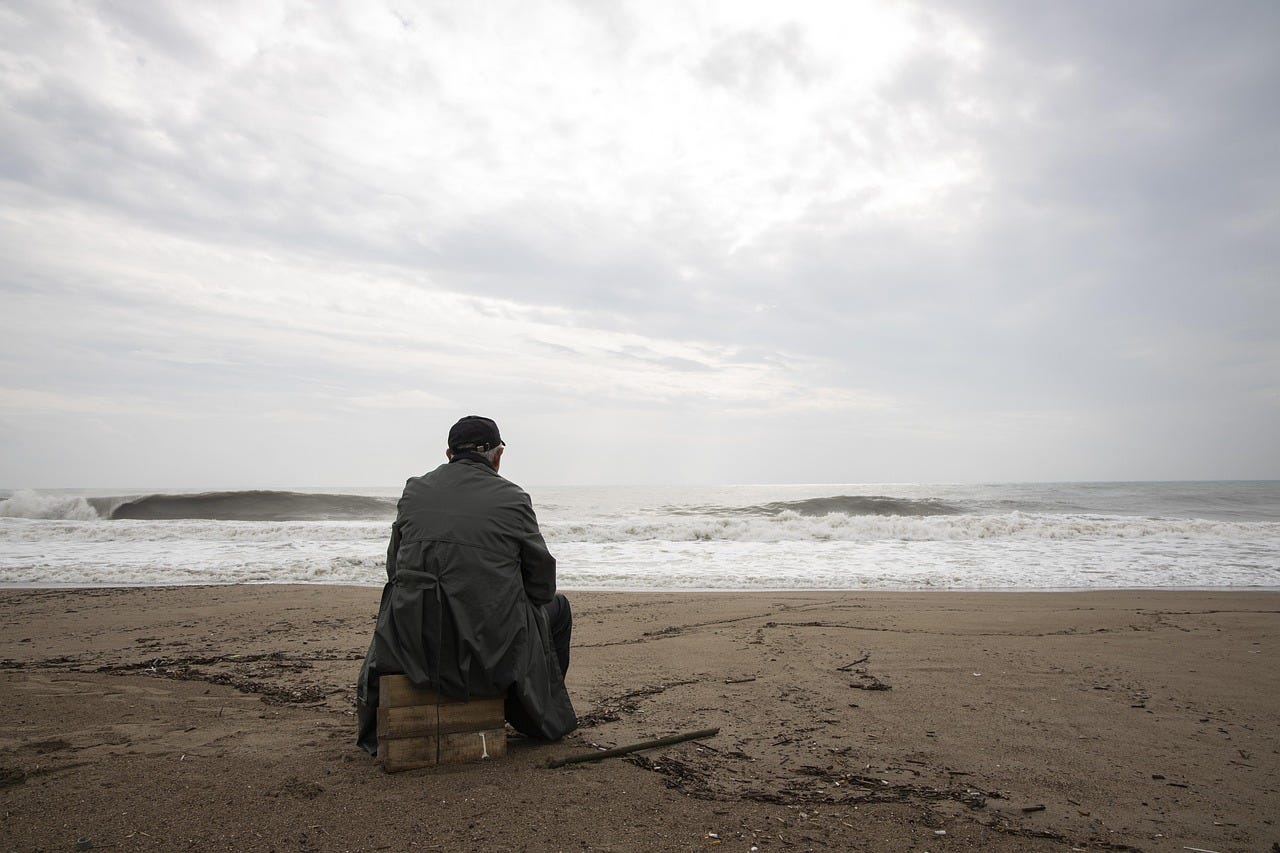
The New York Times reported yesterday:
“Kilmar Armando Abrego Garcia, who was wrongfully deported from the United States last year, arrived in Madrid on Wednesday, ending a 20-month legal fight.”
He left America voluntarily because it became obvious that as part of their childlike pique of revenge (a federal judge has already determined that our government was engaged in “a vindictive abuse of prosecutorial power”), Trump and Miller were about to deport him to Africa.
America — in our names and with our tax dollars — has now officially embraced forms of cruelty and torture that we used to exclusively associate with brutal dictatorships like Russia and China.
Certainly we have a brutal past — I lived through parts of its final years, and am old enough to remember the Whites Only signs at restaurants, hotels, and other places of public accommodation. I remember the beatings at Selma, the murders in Mississippi, and the violence brought against civil rights and anti-war people; I myself both saw and experienced it in my own body in the 1960s.
And that was nothing, of course, to the hundreds of years of chattel slavery, open slaughter of Native Americans, and official oppression of women, gays, and religious minorities that preceded it.
But what we’re experiencing now is something that most of us — and certainly most of the civilized world — thought America had long ago left behind.
Back in the first Trump term, Adam Serwer wrote an article for The Atlantic titled The Cruelty is the Point (later made into a book of the same title), subtitled “President Trump and his supporters find community by rejoicing in the suffering of those they hate and fear.”
He chronicles the stories from the Museum of African-American History and Culture through the modern day and the open — and proudly bragged about — brutality of the first Trump administration, including the child separation, mocking the disabled, the hatred for queer people, and how the MAGA crowd went after Christine Blasey Ford when she dared expose Brett Kavanaugh’s alleged sexual assault of her. He clarified the grim reality:
“This isn’t incoherent. It reflects a clear principle: Only the president and his allies, his supporters, and their anointed are entitled to the rights and protections of the law, and if necessary, immunity from it. The rest of us are entitled only to cruelty, by their whim. This is how the powerful have ever kept the powerless divided and in their place, and enriched themselves in the process.”
Two weeks ago my fellow Oregonian and writer — one of our nation’s most brilliant chroniclers of modern America and our cultural deterioration under the MAGA movement — Nicholas Kristoff wrote what’s arguably the follow-up, tracking down a handful of the hundreds human beings who’ve been brutally rounded up by ICE and then deported to African nations to which they have no relation and where they both look different and don’t speak the language.
He found these men in Juba, the capital city of South Sudan, noting:
“They were nearly starving, can’t regularly communicate with their families or anyone else and don’t have any path to get to their home countries or, in the case of some of them, to ever see their American citizen children again.”
Kristoff documented the horror these men are confronting, alone and now imprisoned in a distant land at a cost to our government that’s absurdly higher than simply keeping them here or sending them to a nearby country were at least they could speak their native languages. He wrote:
“The biggest problem, they said, is a lack of food and water, leading one man to lose 30 pounds and another 50 pounds.
“One of the men, José Manuel Rodríguez-Quiñones, from Cuba, said that he had once asked for clean water and as punishment was locked in his room.
“‘I was locked down for three days,’ he said. ‘I didn’t eat for three days.’ The others confirmed that.Most of the time, each man is given three liters of water — less than a gallon — every two days, for drinking, bathing and toilet flushing, they said.”
I’m familiar with Juba; I was there in March of 2008 as an international relief worker during the Sudanese civil war when South Sudan had declared its independence; I spent a day with the man leading the rebellion, who’d soon become the new nation’s first (and still current) president, Salva Kiir.
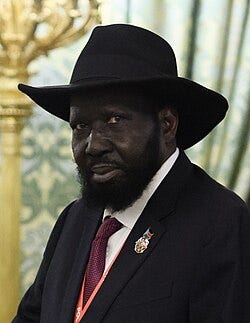
He was a massive man who when we met wore a bandolier with a rifle and bullets and a huge black hat the looked like something out of a spaghetti western. He and I were born the same year (1951) and we had a fascinating conversation about the histories of our two nations, and his hopes for independence. He was also a fierce fighter who was unafraid to kill for his nation’s independence. I was both impressed by his intellect and intimidated by his penchant for violence.
This capital city of South Sudan, Juba, had one paved street that ran a mile or so long. Everything else was dirt. From there, I flew about 500 miles to the north to the border with Darfur and Sudan, where a massive refugee crisis was unfolding (which had brought us to the region).
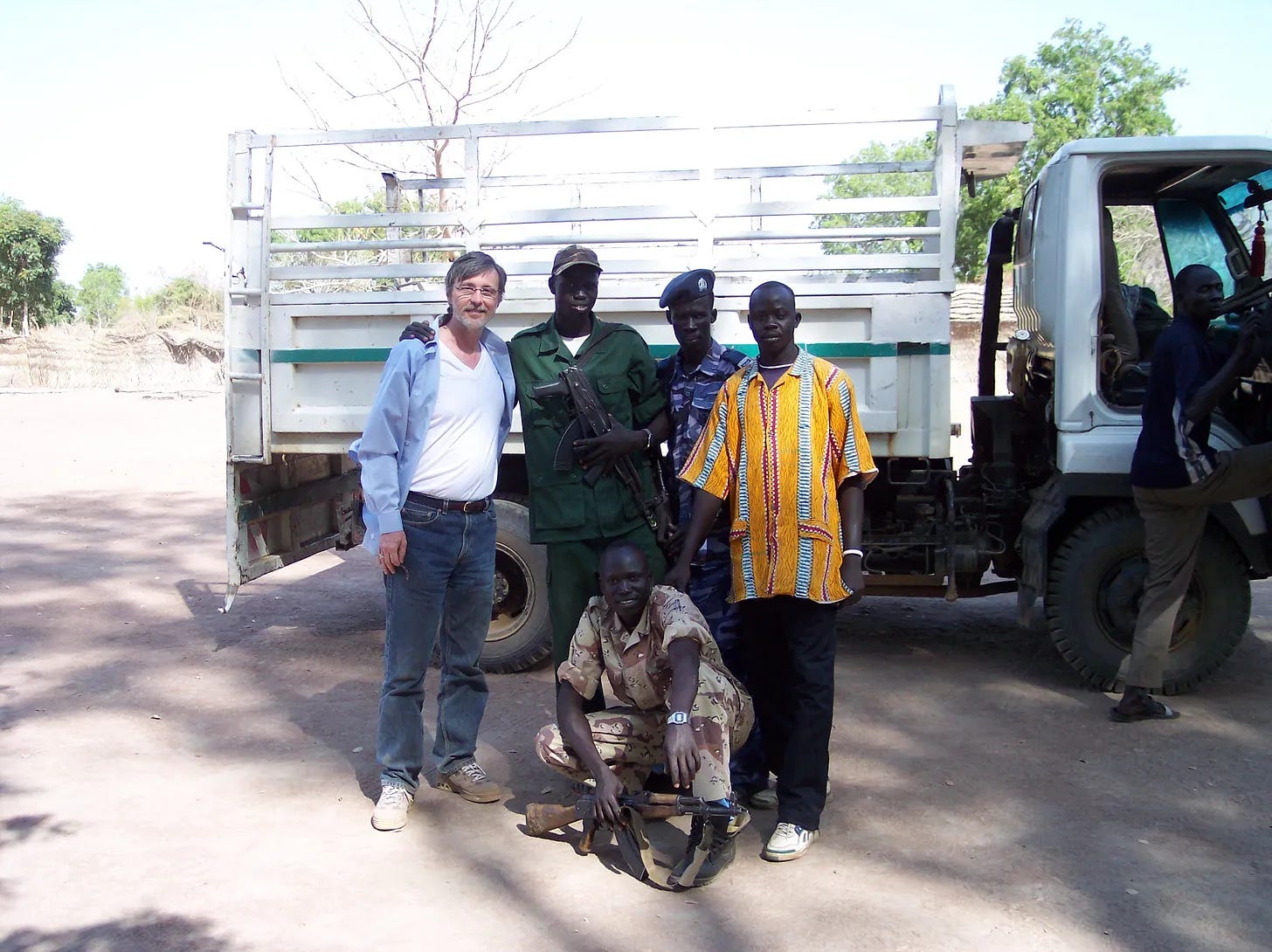
I wrote of the experience in my diary, later published in my book Threshold, the Crisis of Western Culture. It will give you a sense of the experience these unfortunate men Trump had kidnapped from American streets and sent to that distant land are facing:
It’s late morning, and I’m sitting on the dirt ground typing into an old AA battery–operated pocket word processor (a Zaurus ZR5000), in part because the nearest electricity is over five hundred miles away. So is the nearest paved road, and the nearest building made from anything other than mud or grass. This is Gok Machar, South Sudan, just a few miles from the border with Darfur, a village that’s swelled from eight thousand people to more than forty-five thousand as refugees flee the bombings and murders taking place, as I type these words, just a few miles to the northwest. About three hundred people arrived just this morning, most with nothing more than the clothes they were wearing, many with stories of relatives who died along the way as they fled or before the UN could transport them here.
When we first arrived on the African continent we looked out on to the nighttime savannah beyond our Nairobi hotel, and it was truly a startling sight. The landscape was huge, horizon to horizon, like the movies you see of these parts of Africa. The land here in Southern Sudan is just as vast and flat. The forty-five thousand people around me share one single hand-pumped well (drilled a decade ago by the United Nations), and no other infrastructure beyond that. No buildings, no roads, no septic tank or sewage system, no schools, no clinics or hospitals, no stores or even storehouses—nothing. Most live on a patch of reddish dirt about ten feet square with a few of their possessions marking the perimeter of their “home,” sleeping on the dirt or on a ragged piece of cloth or, for the lucky few, a piece of salvaged tarp from some previous relief mission. Stick-thin women and children with bellies swollen by malnutrition outnumber the men, whose peers were murdered by the Janjaweed or taken to the north as slaves.
The air is so hot and dry that even body odor vanishes. My nose is encrusted with dust.
The land is barren of any vegetation, other than the occasional large tree with roots deep enough to reach into the water table thirty or so feet below us. Dust devils blow up and around, tiny cyclones that seem to erupt from nowhere amid air so hot and dry it feels as if we’ve been wrapped in glass-wool insulation and tossed into a furnace’s heating duct.
One relief worker we met on the way here, who was leaving the Darfur area via Juba in Southern Sudan, said, “If there is a hell, it is much like Darfur.”
This being a refugee community, it is thick with disease, as refugees not only bring illness with them but are among the most vulnerable of all populations to disease. Ebola was first discovered here and in nearby Zaire. And there’s Buruli ulcer, an incurable (other than by surgery) flesh-eating disease caused by a bacteria related to leprosy; I saw a case of it yesterday in a girl who had just arrived from Darfur. She had a hole in the side of her shin that was about four inches long, two inches wide, and three quarters of an inch deep, nearly down to the bone.
Eighty percent of the world’s cases of Guinea worm disease are here in Southern Sudan. The worm’s microscopic eggs make their way into the guts of tiny, almost invisible sand fleas, who themselves infest food and water. About three months after an infected flea is ingested, the eggs hatch. Over the course of the next year the Guinea worms grow throughout the human body, often boring through the skin, taking months to fully emerge and causing an ulcer that produces dreadful and incapacitating pain. There is no cure.
In parts of Southern Sudan, sleeping sickness—caused by a parasite named trypanosoma that’s transmitted by the bite of local flies—kills more people than AIDS. This is also the world epicenter of onchocerciasis, a worm that grows to more than one and a half feet long inside the body and spreads thousands of eggs to all the organs—soon to become more worms—over the decade or so it takes to kill a person. Sometimes the smaller worms work their way into the cornea, causing the blindness that gives this illness its common name: river blindness.
There’s also visceral leishmaniasis, tuberculosis, leprosy, yellow fever, dengue fever, various bacteria and mycoplasma that cause severe and deadly forms of pneumonia, and many, many of the people in this village are infected with malaria. (A particularly nasty, drug-resistant, and usually fatal form, P. falciparum, is the most common in Southern Sudan.)[i]