

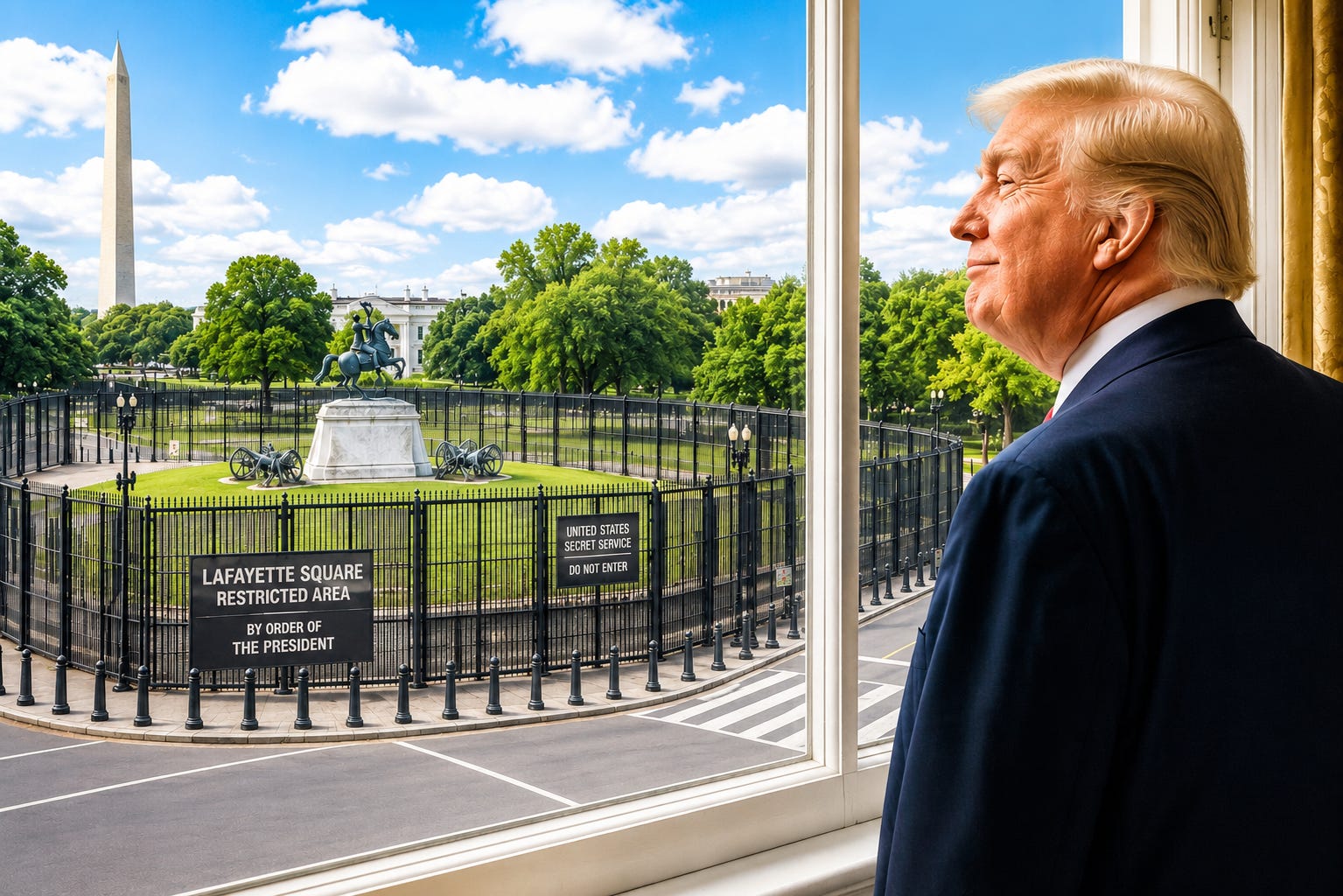
Friday afternoon the Trump administration released a formal proposal to ring Lafayette Square with a permanent fence up to ten feet tall and to install gates across Pennsylvania Avenue at 15th and 17th Streets, all of it designed so officials can seal off America’s most famous protest ground within minutes.
Congresswoman Eleanor Holmes Norton had already introduced legislation to stop Trump, warning that we shouldn’t leave “citizens peering at their democracy from behind permanent fences.”
Lafayette Square is where Alice Paul and her Silent Sentinels stood through freezing winters demanding that Woodrow Wilson support women’s suffrage, and where peaceful protesters were gassed and beaten in June of 2020 so Donald Trump could stroll across the park for a photo op, Bible in hand.
For over two centuries, every president since John Adams has had to look out his window at Americans exercising their First Amendment right to tell him exactly what they think of him.
This administration proposes to end that tradition with steel pickets spaced four inches apart, and to have the whole apparatus ready as we head toward a November election that could break the GOP’s grip on Congress or see open corruption of our election by Trump’s goons, which would inevitably lead to mass protests.
Governments that trust their own people don’t wall themselves off from them; fortress states do.
And by a remarkable coincidence, this was the same week that one of the richest men in Russia gave the world a sixty-hour guided tour of life inside a mature fortress state, along with a warning about where that road ends that every American should know about.
The Economist just published an extraordinary profile of Andrey Melnichenko, whose fertilizer, coal, energy, and logistics empire accounts for roughly one full percent of Russia’s entire GDP, and who was the richest man in the country when Putin invaded Ukraine.
For twenty years Melnichenko lived the bargain Putin offered Russia’s oligarchs: stay out of politics and you can keep your fortune, your yacht, your villa in Switzerland. Then came the Ukraine war, the sanctions, and finally the shakedown.
In 2023, Putin’s prosecutors moved to confiscate one of Melnichenko’s Siberian power companies, and the case quietly evaporated two weeks later, right after he donated 32 billion rubles, about $335 million, to a school for gifted children that operates under Putin’s personal patronage.
In a fully realized oligarchy — like Putin has established in Russia and Trump is trying to create here with pardons and government contracts essentially for sale — that’s what legal property rights become: a subscription service, renewable at the pleasure of the man at the top.
Melnichenko told The Economist that he can see only four possible futures for Russia if it stays on the current course Putin is pursuing, every one of them grim:
— It can crawl back to a victorious West as a defeated vassal, which he predicts would provoke the same revanchist rage that the Versailles treaty incubated in Germany a century ago and that led straight to World War II.
— It can settle permanently into China’s orbit as a resource colony with a flag and faint appearance of independence.
— It can fragment into civil conflict, with warlords fighting over the pieces of a nuclear-armed state.
— Or it can finish its transformation into a continental North Korea, a garrison society sustained by rationing, repression, isolation, and what he describes as turning “external confrontation into a permanent instrument of domestic politics.”
That fourth scenario, which he says is under serious discussion inside the Kremlin, describes a government that identifies permanent enemies abroad and at home to justify permanent repression of its own citizens.
Anyone who’s watched masked federal agents disappearing people off American streets, or read this administration’s directives treating its domestic political opposition as a terrorist threat, or looked at the blueprints for that fence around Lafayette Square, has seen the early architecture of exactly that.
And Melnichenko’s preferred alternative for Russia against these four possibilities? He names it, with a candor you rarely hear from men of his class, as “oligarchy in the classical sense of the word.”
Rule by elites. Businessmen, technocrats, and nationalists would govern the country together, cutting deals among themselves because the four alternatives threaten their fortunes and their family dynasties, while ordinary Russians continue receiving what he frankly admits has so far been “a simulation of participation.”
Surprised that a billionaire’s best imaginable future for his nation is rule by billionaires?
Ours have been saying the same thing out loud for years about America. Peter Thiel, the money behind JD Vance’s entire political career, wrote for the Cato Institute back in 2009 that “I no longer believe that freedom and democracy are compatible,” and he and many of his morbidly rich colleagues have spent the years since funding politicians and projects built explicitly to act on that conviction.
Melnichenko is a useful analyst for this critical time in both Russian and American history precisely because he’s no cartoon villain, and he’s barely ideological at all.
Ammonia from his plants ends up in Russian munitions, he coordinates with Putin’s military and secret police to protect his factories from Ukrainian drones, and he explicitly avoids “moral judgments” about things like democracy because he considers them a “distraction” from “designing systems that work.” Sort of like when Elon Musk said:
“The fundamental weakness of Western civilization is empathy.“
Honoré de Balzac gets credit for the observation that, “Behind every great fortune lies a great crime,” and Melnichenko’s own history, which began with an illegal currency exchange run out of a Moscow State University dorm room and protected by moonlighting police cadets, fits the pattern comfortably.
His way of thinking is common among men who’ve accumulated billions: they deal in what works, what maintains stability, what’s most efficient, and who can be bought or brought along, while “esoteric” and “idealistic” concepts like democracy, individual rights, and “the pursuit of happiness” only enter the calculation as variables to be managed.
That same mindset built America’s modern oligarchy. Exxon’s own scientists, for example, predicted global warming with alarming internal memos starting in the late 1970s, and the company’s executives, having weighed the future of our planet and our children against their bottom line, spent the next four decades funding lies to keep us burning their product and filling their money bins.
It was nothing personal: they were simply setting aside empathy while optimizing their own incomes, and the habitability of our planet was simply a variable.
The blueprint for the larger project was drafted in 1971, when tobacco lawyer Lewis Powell, two months before Nixon put him on the Supreme Court, sent a confidential memorandum to the US Chamber of Commerce calling on American business to organize, fund, and capture the universities, the media, the courts, and the American political system itself.
Out of that memo grew the think tanks, the “scholars for hire,” and the vast rightwing media machines that have spent five decades teaching Americans to distrust their own government, oligarchs arguing essentially that oligarchy is preferable to democracy.
Reagan’s functional suspension of our anti-monopoly laws in the 1980s then let a handful of men amass fortunes larger than any human beings had ever held, morbidly rich on a scale even the pharaohs never dreamed of, and today those men fund virtually every Republican in Congress along with a distressing number of Democrats.
Their wholly-owned toadies on the Supreme Court have spent the last half-century legalizing the purchase of the American government, a story I tell at length in my new book Who Killed the American Dream?
The foundation was a fraudulent headnote slipped into an 1886 Supreme Court decision falsely claiming the Court had ruled that corporations are persons with rights under the 14th Amendment; Citizens United built on that fraud in 2010 by declaring that corporate and billionaire money is constitutionally protected speech.
But it gets worse: in 2024 the Court’s six corrupt Republicans ruled in Snyder v. United States that officials who take payments after performing favors have merely accepted legal “gratuities” rather than bribes. Yeah, billionaires can now legally give tips to judges and politicians.
And just two weeks ago the same six on-the-take justices struck down the post-Watergate limits on coordinated party spending, freeing the morbidly rich to invisibly pour unlimited money through the parties directly into their chosen candidates’ campaigns, four months before the midterms. Justice Kagan warned in dissent that the RNC and DNC can now simply function as an oligarch’s or corporation’s secret checking account for their selected candidates and the public will never know who bought their election and owns their politicians.
Putin’s oligarchs and ours arrived by opposite roads: his through a state that swallowed its billionaires and ours through billionaires who swallowed their state, but the citizens of both countries ended up in the same place under either arrangement: on the outside, holding a “simulation of participation” while men like Musk buy our elections and the favors our politicians can bestow.
So Americans should ask the question Melnichenko asked about Russia: What futures are actually on our menu? I can count four, and the parallels are uncomfortable.
The first is aristocratic dictatorship. America completes its realignment away from the world’s democracies and toward Moscow, Beijing, and the Gulf monarchies that Trump and Vance so visibly admire, and the world gets run as a cartel of strongmen and sovereign wealth funds while our Constitution becomes a mere decoration. Much of our current foreign policy already points in this direction.
The second is civil conflict that tears our country apart. Prominent voices on the right have been openly fantasizing about civil war for years, and a government that expects to be loved doesn’t need a ten-foot fence around Lafayette Square or gates across Pennsylvania Avenue. Building permanent infrastructure to wall off protest four months before a national election shouts at us that Trump and Vance are planning for a coming confrontation with the American people.
The third is slow imperial decline, the road Britain walked after the two world wars: a once-dominant nation growing gradually poorer, shabbier, and more irrelevant while its aristocracy extracts whatever’s left. This is oligarchy’s default trajectory, the one we’re already on if nothing dramatic intervenes, and it ends with our grandchildren living in a country that used to matter but is now subject to the whims of its oligarchs and more powerful nations.
The fourth is democratic renewal, the road Abraham Lincoln and Franklin Roosevelt opened and JFK and LBJ paved: breaking up concentrated wealth and power, taxing the morbidly rich, and building the healthcare, education, childcare, and retirement security that working people in Scandinavia and most of the rest of the developed world now take for granted.
Unlike the other three, this future has a living constituency and a vibrancy that’s been missing from the American political scene since the days of JFK.
Just three weeks ago, voters across New York swept young progressives and democratic socialists into Democratic nominations, toppling establishment incumbents despite millions in super PAC money arrayed against them, because ordinary Americans keep voting for economic democracy whenever somebody credible actually offers it.
Russia is probably too far down the road of tyranny to make a sudden transition like this back to democracy; its independent press is dead, its opposition leaders are in prison, in exile, or in the ground, and even its billionaire would-be reformer can’t imagine anything better than a politer class of elites running the place.
We’re not there yet. Our elections still mostly count, some of our courts still hold, our press is battered but breathing, and we still retain the right, for now, to stand in front of the White House and say, “No!” Every one of those things is on the ballot this November, and the people fencing off Lafayette Square understand that better than most.
Melnichenko offered one more observation that applies as much to Washington as to Moscow:
The Russian regime looked absolutely impregnable in 1913, and again in 1986, and both of those governments were gone within a few years. He quotes former Russian prime minister Yegor Gaidar’s line that, “Big changes come later than we think but earlier than we expect.”
That’s true of dictatorships, and it’s equally true of oligarchies as I point out in The Hidden History of American Oligarchy.
Working people get angry when confronted with an exploitative rule by the rich and then rise up in revolt. We can see this happening in Argentina right this moment.
At that point, a nation’s leadership must choose between abandoning oligarchy and going back to democracy — as we did with Lincoln taking on the oligarchs of the Confederacy in 1861, and FDR’s New Deal presidency in 1933 — or bringing down the iron fist and converting the oligarchy into dictatorship, as Putin did in Russia.
Oligarchy, as I detail in that book, is always a transitional form of government that either reverts to democracy or transitions to dictatorship. It rarely last more than a single generation.
Thus, which kind of sudden change America experiences — the hard snap into strongman rule or the breaking of billionaire power over our government, purging dark money, and a restoration of democracy — will largely be decided by what we all do between now and the first Tuesday in November.
They’re building a fence around the town square, so our answer must be to make it useless by showing up everywhere they can’t fence. Call your senators and representative through the Capitol Switchboard at 202-224-3121 and demand they block the permanent fencing of Lafayette Square and pass real protections for the November election.
Check your voter registration today at vote.org, because purges are already underway in multiple Red states, and save the Election Protection hotline, 866-OUR-VOTE, in your phone right now.
Democracy, as Bernie said on my program every Friday for 11 years, has never been a spectator sport, and this is the year that old cliché becomes literal. If this article helped you see the stakes, please share it widely and support independent journalism by subscribing at hartmannreport.com; the oligarchs own their media, and we have to sustain our own.
Louise’s Daily Song: “The Oligarch’s Warning”
Comments on the Saturday Report:
Saturday Report 7/11/26 — Trump refuses to sign the biggest housing bill in a generation, ICE shoots the wrong man in Houston, and the referees of our elections get purged...
The 21st Century Road to Housing Act became law despite the President. His version of a protest is not signing a popular law? What an idiot! Still, it’s nice to know his name is not on it.
~ alis
“ICE shoots the wrong man in Houston”.
If these ICE goons had shot their intended victim instead of the “wrong man”, would the headline have changed to “ICE shoots the right man in Houston”? Just asking.
~ James W
Get the day’s news, both as a video and written report by Thom Hartmann, as well as a downloadable or an audio podcast, delivered right to your inbox every morning for free at CommonwealthReport.news:

My newest book, Who Killed the American Dream?: The Greatest Political Crime Ever Told is now available from bookstores nationwide. It’s a modern-day telling of the “murder mystery” of how, in 1886, a great crime was committed against America by a cynical court reporter and an on-the-take Supreme Court justice that changed the course of American politics and led straight to Citizens United. It also details the massive ongoing cover-up of this crime and what we can do to fight back.

Is there any doubt that we are already living in a right wing fascist dictatorship, especially with the latest news that Trump is going to employ armed federal poll watchers into AZ, MI, MN, NH, NY, VA. ICE can murder, abduct, beat people with no fear of consequence. disappear people into concentration camps (yes that is what they are, filthy, dirty, camps without adequate food, sanitation, or medical care. America's own Dachau, Auschwitz, and like them, the regime wants to use them for free labor.
The Musk quote, “The fundamental weakness of Western civilization is empathy", is a chilling view in the hands of anyone with power.
Imagine sitting down with your daughter's fiance, and having him say "The fundamental weakness of marriage is empathy".
Or getting called into an all-hands meeting at work and being told, "The fundamental problem with the management of this company is empathy".
This opinion, widely shared by spoiled, entitled brats who have reached a position of power through successful implementation of a single good idea (think Musk, Bezos), pure luck (Zuckerberg et. al.), or simple inheritance (don't have to go further than Trump, here) can be translated to this far more accurate opinion:
"The fundamental weakness of any power structure in which I participate is anything that makes me consider giving someone else something I want to keep".
When oligarchies reach a tipping point at which those in power, who truly believe that the biggest impediment to the maximization of their fortunes is the need to consider anyone else's needs - empathy, in Musk's terms - can act on that belief with impunity, we are truly at an end stage where government by the people is a mirage and true control rests fully in the hands of those with the money to buy it.
We are already very close to that state of affairs. It's likely the midterms will decide which direction we go.