

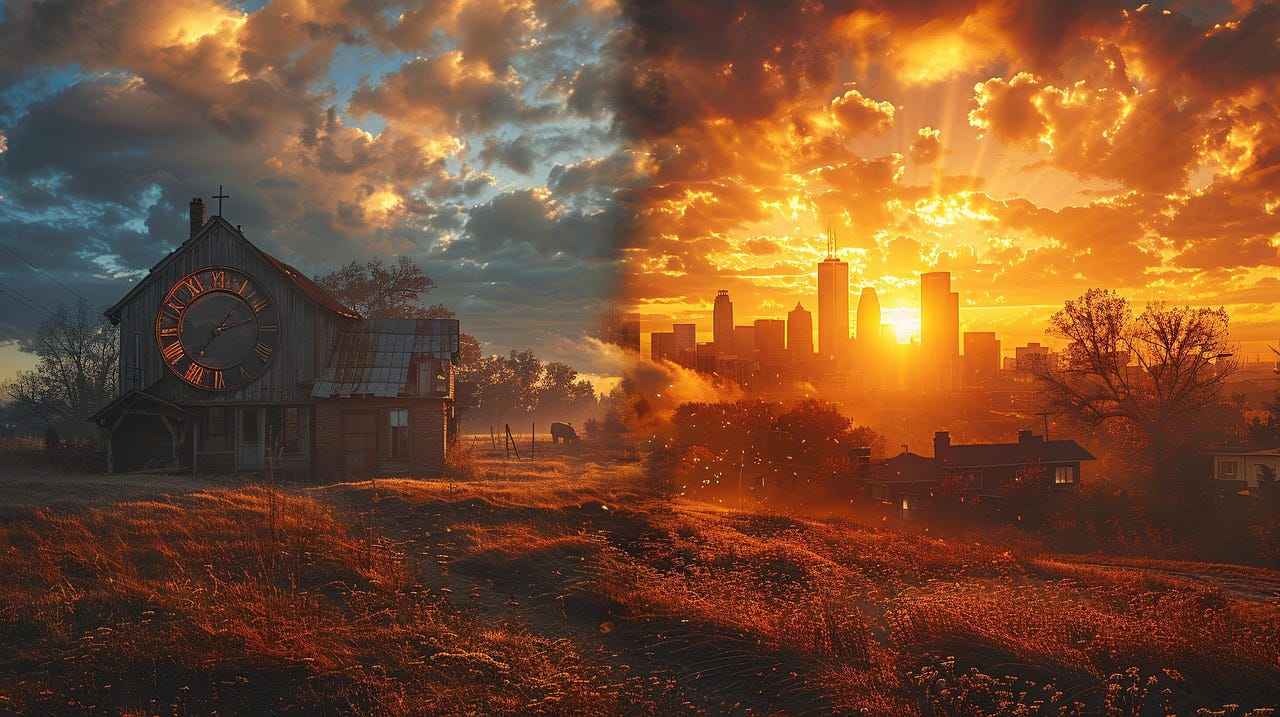
His greed seems to have no limits: Trump wants to make more money off his golf courses, and you and your kids may pay for it with your lives. And one lone Republican is standing up to him.
Back in 1974, the year Richard Nixon put into place year-round daylight savings time, Louise and I were living just outside Lansing, Michigan. I remember the sun not coming up that January until nine in the morning; we drove to work in full darkness, kids stood under streetlights to catch the school bus, and eight schoolchildren were killed in traffic accidents in Florida alone.
When Nixon first flipped the switch, 79 percent of Americans supported year-round daylight savings time; by the end of 1974 that had collapsed to 42 percent support. President Gerald Ford signed the repeal that October.
The biggest force behind this bizarre idea of year-round daylight savings time was the golf course industry. The Englishman who invented the idea of shifting the clocks was an avid golfer named William Willett; the whole idea was to give golfers another hour to play in the evening.
The golf industry told Congress back in 1986 that adding just one more month to the months of daylight savings time would make the industry at least an additional $200 million a year; they got their extension. It was all about the money and had nothing to do with science.
And now, fifty-two years later, Congress is about to repeat the mistake because they’re being leaned on hard by Trump, who reported that just last year he made nearly $395 million from people playing golf at his 16 golf courses.
The House passed the Sunshine Protection Act on July 14 by a vote of 308 to 117, and it’s been sitting in the Senate ever since. The guy blocking it is Senator Tom Cotton, so Trump published Cotton’s personal cell phone number and suggested people convey his message to the Senator, which he posted on his Nazi-infested social media site begging for more money for himself:
“The PGA TOUR, as an example, needs more Daylight in the afternoon in order to finish their Tournaments. Likewise, regular Golfers, Tennis Players, Hunters and, perhaps most importantly, Farmers who want more Daylight to play or work.”
Farmers, for the record, have hated daylight saving time since 1918, because cows don’t read clocks. But golf is another story, and, like the fossil fuel industry, it’s all about the money. This time, though, we have science that was largely unknown (but certainly intuited) back when Nixon was president.
Three weeks ago the Canadian Medical Association Journal published a peer-reviewed analysis by a team of sleep scientists, psychiatrists, and economists who went through the whole body of research. Their conclusion was blunt, as Ralph Mistlberger, the Simon Fraser University chronobiologist who co-authored it, explained:
“Morning light is the primary environmental time cue that aligns our biological clocks to local time. If morning light is delayed, our clocks and all the rhythms they control are delayed.”
It turns out that our bodies don’t run on the clock on the wall; we’re calibrated and recalibrated every day by exposure to sunlight. It resets the cluster of cells behind the optic nerve that then tell every organ in your body what time it is and what they need to be doing about and for it. And daylight savings time pushes that signal back an hour in the winter when we’re already struggling (particularly in the north half of the country) with early-morning darkness.
The researchers went granular, finding that just within a single time zone, people living on the western edge — where the sun comes up just slightly later than on the eastern edge — sleep nearly an hour less per week. Those living on the western edges of time zones ended up with measurably worse moods, lower productivity and even demonstrably poorer school performance. The American Academy of Sleep Medicine reached the same conclusion back in 2023, as have essentially every other sleep and circadian science organization that’s weighed in since then.
Our kids will pay the steepest price for this boon for the golf industry that the Senate is on the verge of inflicting on us all at Trump’s insistence.
Research done by the online-schooling company K12 found that under permanent daylight savings time fully 94 of the largest 100 school districts in the country would have children leaving for school in the dark every single winter morning. The average large district would see 117 dark commutes a year, compared with 77 under the system we have now and just 35 under permanent standard time.
Russia tried permanent daylight time in 2011 and reversed it three years later. Chile tried it in 2015 and reversed it. We tried it in 1974 and reversed it. Tom Cotton, whatever else you think of him, got this one right when he said:
“No one likes changing the clock, me included, but Congress has enacted permanent Daylight Saving Time multiple times before and repealed it each time once Americans experienced absurdly late sunrises in the winter.”
Pretty much everybody is tired of the twice-a-year clock changes. We have more traffic accidents in the week following the change, as the entire country is experiencing a bit of jet lag.
University of Colorado researchers combed through 22 years of federal car accident data and found that traffic fatalities jump about 6 percent in the week after clocks spring forward. A Michigan hospital study found heart attacks up 24 percent on the morning after the spring change. And a study of over 20 years of injuries in the mining industry found workers got hurt more often and were less productive the day after the change.