

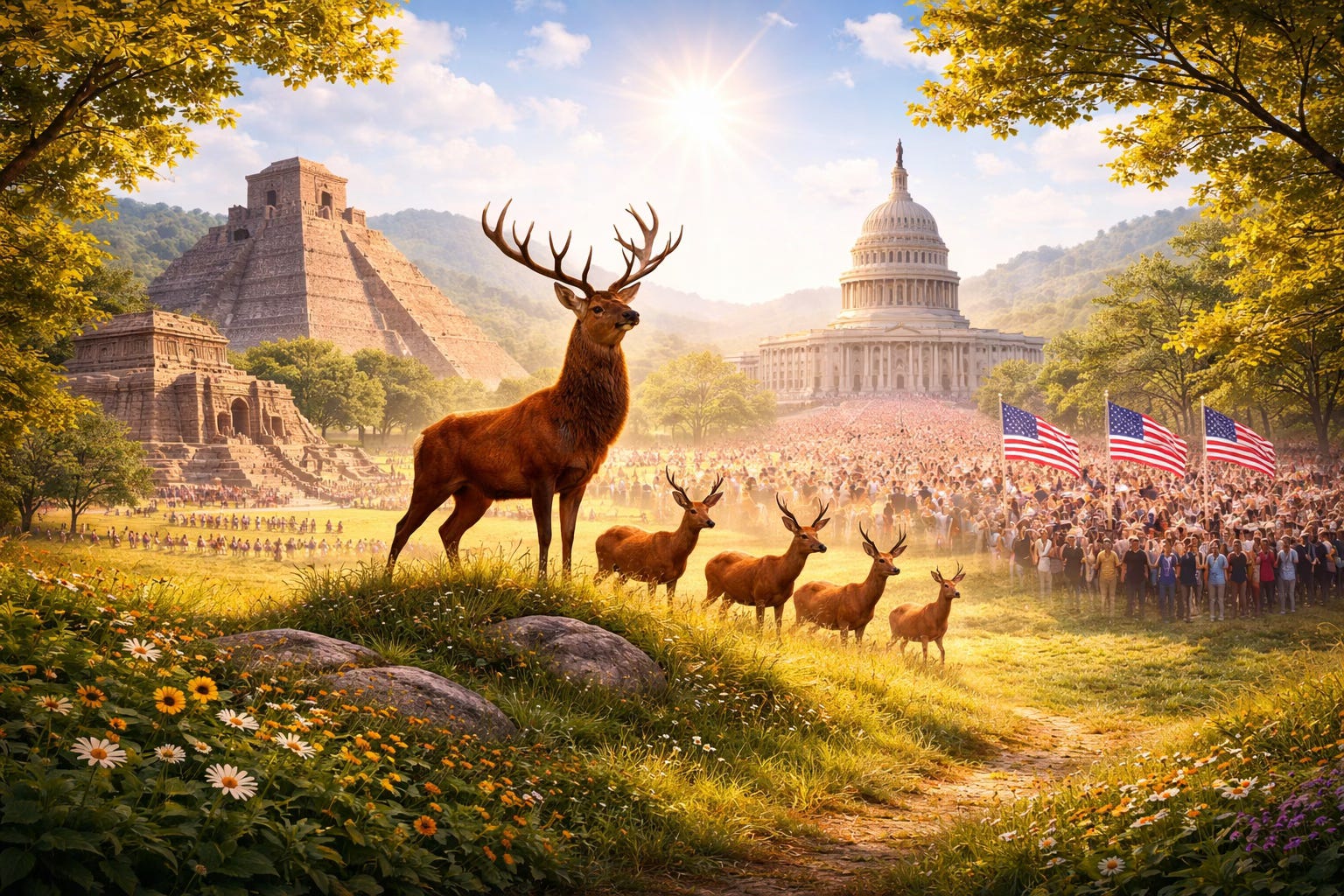
FCC Chairman and apparent Goebbels fanboy Brendan Carr is suggesting the radio and TV broadcasters he regulates should begin airing more “pro-America” content. What he means, of course, is pro-Trump.
This illustrates a much larger reality: Republicans want a top-down, hierarchical political and economic system. Democrats want a bottom-up system with maximum participation and broad sharing of society’s wealth. Who is right?
Donald Trump just went on a rant about economics, oil, and Iran that has massive implications for the future of our nation. At the same time, a new study was published about how people lived in Mesoamerica before the European conquest that shows as many as half of all those ancient societies lived democratically and had a relatively egalitarian distribution of wealth.
It seems like these are separate, disconnected stories, but they’re not. And the tale they both tell gives us a major insight into the future of America, for better or worse, depending on the political decisions we make between now and November.
The stakes are getting higher every day, and it’s critical that we all understand how cultural and political evolution and world history led us to this dangerous and opportune moment.
We tend to think of economies and political systems as separate things, but in reality they’re deeply intertwined. Both either can be fragile or resilient, and that fragility or resilience most often depends on their relationship to each other.
Resilience is the ability of a governmental system or an economy to weather stresses without “breaking.” It’s the key to understanding everything that’s happening today in both politics and economics.
One of the best and most widely cited analyses of the difference in resilience between democracy and autocracy, for example, is the paper by Wolfgang Merkel & Anna Lührmann titled Resilience of democracies: responses to illiberal and authoritarian challenges published in the peer-reviewed journal Democratization.
Noting that, “Illiberalism and authoritarianism have become major threats to democracy across the world,” they point out that:
“The more democracies are resilient on all four levels of the political system (political community, institutions, actors, citizens) the less vulnerable they turn out to be in the present and future.”
As I document in my book, The Hidden History of American Democracy: Recovering Humanity’s Ancient Way of Living, democracy is the default system for nearly every species of animal and the historic majority of human societies prior to the so-called Agricultural Revolution.
And America’s Founders — having actually seen it being lived out by Native people — believed in it. Franklin, Adams, and Jefferson all wrote about their experiences with the “Indians” extensively, and the lessons they learned from them that made their way into our Constitution.
From Putin’s disastrous attack on Ukraine to the governments of Iran and Afghanistan being controlled entirely by a small subset of religious men, we see the calamitous consequences of rule by the few.
Thus, we find that democracy — a system of decision- and rule-making that most efficiently encompasses the collective wisdom of the group — is a survival system every bit as important as technology, science, and economics.
Democracy doesn’t rule out leadership or hierarchies of wealth or power. Rather, it specifies that the power determining how those hierarchies are formed, maintained, and determined — who’s in charge, in other words — comes from, as Thomas Jefferson wrote in the Declaration of Independence, “the consent of the governed.”
And we get there through voting.
This use of voting-based democracy to establish and maintain the resilience — the survival potential — of a group, tribe, nation, or even animal species is so universal that it’s not limited to human beings.
In the Declaration of Independence’s first paragraph, for example, Jefferson wrote that “the laws of nature and of nature’s God” compelled America’s Founders to reject British oligarchy and embrace democracy.
It got him into a fight with the Declaration’s main editor, John Adams, who thought it should say “the Christian God,” but Jefferson prevailed. His deist friends like George Washington, Dr. Benjamin Rush, and Ben Franklin knew what he meant: nature and “God” interpenetrated each other, and they saw the result of that in the democracy — the balancing systems that produced ecological resilience — played out in nature.
And, I discovered when researching my book, Franklin in particular believed after decades of experience working with Native American tribes that those rules of nature are as universal to humans as they are to all other animals on earth.
But was he right? Is nature actually democratic?
Biologists Tim Roper and L. Conradt at the School of Biological Sciences, University of Sussex, England, studied this issue in animals.
We’ve always assumed that the alpha or leader animal of the herd or group makes the decisions, and the others follow, like human kings and queens of old. The leader knows best, we believe: he or she is prepared for that genetically by generations of Darwinian natural selection, or ordained by an omnipotent sky god.
But it turns out that there’s a system for voting among animals, from honeybees to primates, and we’ve just never noticed it because we weren’t looking for it.
“Many authors have assumed despotism without testing [for democracy],” Roper and Conradt noted in Nature, “because the feasibility of democracy, which requires the ability to vote and to count votes, is not immediately obvious in non-humans.”
Stepping into this vacuum of knowledge, the two scientists decided to create a testable model that “compares the synchronization costs of despotic and democratic groups.”
They and their research group discovered that when a single leader (what they call a despot) or a small group of leaders (the animal equivalent of an oligarchy) make the choices, the swings into extremes of behavior tend to be greater and more dangerous to the long-term survival of the group.
Wrong decisions, they hypothesized, would be made often enough to put the survival of the group at risk because in a despotic model the overall needs of the entire group are measured only through the lens of the leader’s needs.
With democratic decision-making, however, the overall knowledge and wisdom of the entire group, as well as the needs of the entire group, come into play. The outcome is less likely to harm anybody, and the group’s probability of survival is enhanced.
“Democratic decisions are more beneficial primarily because they tend to produce less extreme decisions,” they note in the abstract to their paper.
Britain’s leading mass-circulation science journal, New Scientist, looked at how Conradt and Roper’s model actually played out in the natural world. They examined the behavior of a herd of red deer, which are social animals with alpha “leaders.”
What they found was startling: red deer always behave democratically. When more than half the animals were pointing their bodies at a particular water hole, for example, the entire group would then move in that direction.
“In the case of real red deer,” James Randerson noted, “the animals do indeed vote with their feet by standing up. Likewise, with groups of African buffalo, individuals decide where to go by pointing in their preferred direction. The group takes the average and heads that way.”
This explains in part the “flock,” “swarm” and “school” nature of birds, gnats, and fish.
With each wingbeat or fin motion, each member is “voting” for the direction the flock, swarm or school should move; when the 51% threshold is hit, the entire group moves as if telepathically synchronized.
Dr. Tim Roper told me:
“Quite a lot of people have said, ‘My gorillas do that, or my animals do that.’ On an informal, anecdotal basis it [the article] seems to have triggered an, ‘Oh, yes, that’s quite true’ reaction in field workers.”
I asked him if his theory that animals — and, by inference, humans in their “natural state” — operating democratically contradicted Darwin.
He was emphatic:
“I don’t think it is [at variance with Darwin]. … So the point about this model is that democratic decision-making is best for all the individuals in the group, as opposed to following a leader, a dominant individual. So we see it as an individual selection model, and so it’s not incompatible with Darwin at all.“
Franklin and Jefferson were right. Democracy, it turns out, is the norm in nature’s god’s animal kingdom, for the simple reason that it confers the greatest likelihood the group will survive and prosper.
When democracies begin to drift away from this fundamental principle, and those who have accumulated wealth and the political power typically associated with it acquire the ability to influence or even control the rule-making process, democracy begins to fail. It becomes rigid and fragile.
When this process becomes advanced, democracies typically morph first into oligarchies (where we largely are now because five corrupt Republicans on the Supreme Court legalized political bribery in Citizens United) and then Putin-like dictatorships (where Trump, DeSantis, and the other wannabee autocrats in the GOP want to take us).
Similarly, research on pre-European-contact Mesoamerican societies published by archeologists Gary M. Feinman and David M. Carballo validates the extensive claims by America’s Founders that I cited in my Democracy book: the most resilient and longest-surviving aboriginal and indigenous societies were also the most democratic.
Citing a 2018 study they’d published of 26 pre-contact Mesoamerican cities, the researchers were every bit as explicit about humans as had been Conradt, Roper and Randerson about the red deer:
“We found that more than half of them were not despotically ruled and that the more collective political centers had greater resilience in the face of droughts and floods, and warfare or shifts in trade. Cities that addressed their social challenges using more collective forms of governance and resource management were both larger and somewhat more resilient than the cities with personalized rulership and more concentrated political power.”
Digging deeper into the archeological record in the five years since that publication, they wrote:
“In a later study that included an updated and expanded sample of 32 well-researched Mesoamerican cities, we found that centers that were both more bottom-up and collective in their governance were more resilient.”
Thus, the kind of bottom-up democracy advocated by Democrats — where the largest number of people can vote, pluralism is encouraged, and the will of the people is respected even when it means your party loses power — has sustained America through most of our history (and has been continuously improved, in fits and starts, through the progressive enfranchisement of African Americans, women, and naturalized immigrants).
On the other hand, restricting democracy (as the MAGA GOP is committed to with their SAVE Act) by making it harder to vote, concentrating political power from the top-down, and using hate and demonization of racial, religious, and gender minorities to acquire and hold political power leads a society straight toward autocracy, fascism, and — most importantly in this context — a loss of cultural, political, and societal resilience.
The legacy of Reagan’s rejection of classical Adam Smith economics and adoption of trickle-down neoliberalism, along with GOP big lies about non-citizens voting and the “virtue” of high-minded “brilliant” billionaires making our decisions for us, made America less resilient and more vulnerable to being shattered by internal or external shocks.
They shook our confidence in government so severely that we elected a populist psychopath as president simply because he promised to “drain the swamp.”
Americans knew something was very, very wrong; they just hadn’t figured out that it all began decades ago with Reagan’s completely reordering the American economy and the GOP consciously deciding to exploit racial hate, homophobia, and misogyny as a political weapon.
America is now, with the upcoming No Kings marches and this November’s election, on a new and brighter course, one that comports with a genuine scientific and historic understanding of how to build and maintain resilient societies and economies.
Now all we have to do is work like hell to help America reject the fascists and re-embrace democracy.
The song that was inspired by this article is here.
My reading this article as an audio podcast is here.
My newest book, Who Killed the American Dream?: The Greatest Political Crime Ever Told is now available for presale from bookstores nationwide.
You can follow me on Blue Sky here: https://bsky.app/profile/thomhartmann.bsky.social

All this philosophical -- and even economic -- stuff is great, but the onyl thing that actually moves Congressional Republicans is Epstein.
This morning Heather Cox Richardson reports that beginning in December 2010 under the Obama administration, the U.S. Drug Enforcement Agency (DEA) was running an investigation of Jeffrey Epstein and fourteen other people for drug trafficking, prostitution, and money laundering called Operation Chain Reaction.
"It suggests the government had ample evidence indicating he was engaged in large scale drug trafficking and prostitution as part of cross-border criminal conspiracy and that Epstein was likely pumping his victims, including underage girls, with incapacitating drugs to facilitate abuse. I am at a loss to understand why you are blocking further investigation of this matter.”
Wyden says that the document in the files was “clearly marked as ‘unclassified’ at the top of every single page.”
DOJ is preventing Sen, Ron Wyden from getting the documentation from DEA. Ther DOJ of course is led by Trump's personal lawyers. Yesterday they tried to undermine the subpoena issued to Bondi by staging a "hearing" which actually was a PR stunt.
We have a day of action scheduled for March 28. We should be pressuring Congressional Republicans on Epstein. They are all in over everything else.
Michele Leonhart was the head of the Drug Enforcement Administration (DEA) for the majority of 2015, serving as Administrator until her resignation in May of that year. Following her departure, Chuck Rosenberg took over as acting Administrator..
What do they know, Thom?
Meanwhile Scott Bessent is stopping Wyden from getting other financial records. Please ask Khanna to ask the House Oversight Committee to subpoena the two sets of records.
I'm. asking my Republican rep to get involved.
.
Luke Kemp, author of "Goliath's Curse," argues that evidence from the study of 342 collapsed states suggests that elites took control, leading to extreme social, political, and economic inequality and, ultimately, collapse. He argues, like Hartmann, that democratic societies are more resilient and long-lasting. Oligarchs with dark-triad personalities don't make the best decisions for civilization when faced with shocks such as droughts, volcanic eruptions, earthquakes, or invasions by neighbors. The elites are worse off than the masses, who often become better off. Kemp doesn't think the masses of modern civilization would be better off, but makes a good case that they were in the past.
Hartmann's book, part of the Hidden History series, "Democracy: Rediscovering Humanity's Ancient Way of Living," is especially interesting in part I, "The Founders Meet Ancient Democracy."