

Ka$h Patel’s (his preferred spelling) pathetic performance before Congress last week has left many Americans wondering what’s going on with our federal government. We now have, as a result of Trump’s choices and the endorsement of every or virtually every Republican in the US Senate:
— An alcoholic B-list weekend TV star in charge of our military,
— A formerly heroin- and sex-addicted brainworm-infected lawyer in charge of our public health,
— A wrestling promoter in charge of our Education Department,
— The president’s personal criminal defense lawyer in charge of the Justice Department,
— A C-list reality TV star in charge of our air traffic control system,
— A plumber in charge of Homeland Security,
— A “miracle weight-loss pill” TV hawker in charge of Medicare and Medicaid,
— A social media hustler and children’s book author in charge of the FBI,
— A predatory hedge fund guy in charge of the Treasury,
— A fracking CEO who denies the climate crisis in charge of the Energy Department,
— Jeffrey Epstein’s former next-door neighbor and Epstein Island visitor in charge of the Commerce Department,
— A politician who built his career on a phony story about his parents fleeing Castro in charge of telling America's story to the world,
— The mentee of an anti-democracy billionaire as our VP,
— A Project 2025 architect who was excited to put federal workers “in trauma” in charge of America’s federal budget,
— A racist whose own uncle publicly denounced him as an immigration hypocrite, and whose leaked emails pushed white nationalist material to Breitbart, in charge of immigration policy,
— A former NFL player in charge of public housing,
— A real estate developer and golf buddy with no diplomatic experience whatsoever negotiating with and sucking up to Vladimir Putin,
— The world’s richest man firing people investigating him and his companies while gutting the federal government and killing millions by “feeding USAID into the wood chipper,”
— And a self-described “proud Islamophobe” with no government job vetting the National Security Council staff.
The model here is straightforward: government is something to be exploited for personal gain not public service, because government is essentially an evil thing. So, load it up with incompetents, suck up as much money as you can, and leave the mess to the Democrats:
— Three Republican presidents borrowed over $35 trillion, put it all on the national credit card, just to hand all that money to the billionaires who fund their campaigns and sustain their lavish lifestyles.
— Republicans in Congress have thrown millions off of food stamps (SNAP) and Medicaid and refuse to fix Social Security or Medicare.
— Trump just discarded many of our pollution rules, a move that will lead to more cancers and asthma among our children.
— Bob Kennedy saluted putting cancer-causing chemicals on our food supply.
— Anything Putin wants from Trump he gets.
— They’re selling off public lands and destroying our park system like there’s no tomorrow, while rewriting America’s history into a white supremacist fantasy.
— Miller’s ICE goons are murdering Americans and getting away with it while imprisoning brown-skinned people without due process.
— Trump has made billions since becoming president through crypto scams and bets on his own war proclamations.
And that’s just the beginning. Which is causing millions of Americans, scratching their heads in wonder, to ask:
“Where did this anti-American-government insanity come from, and how did it come to seize control of the entire Republican Party?”
It all started with the Libertarians
Reporter Mark Ames documents how, back in the 1940s, a real estate lobbying group came up with the idea of creating a new political party to justify deregulating the real estate and finance industries so they could make more money.
This new Libertarian Party would give an ideological and political cover to their goal of becoming government-free, and they developed an elaborate pretense of governing philosophy around it.
Their principal argument was that if everybody acted separately and independently, in all cases with maximum selfishness, such behavior would actually benefit society. There would be no government needed beyond an army, a police force, and a court system to defend the rights of property owners. It was a bizarre twisting of Adam Smith’s reference to the “invisible hand” that regulated trade among nations.
In 1980, billionaire David Koch ran for vice president on the newly formed Libertarian Party ticket. His platform included calls to privatize the Post Office, close public schools, give Medicare and Medicaid to big insurance companies, end food and housing support and all other forms of “welfare,” deregulate all corporate oversight while shutting down the EPA and FDA, and selling off much of the federal government’s land and other assets to billionaires and big corporations.
Reagan, who won that 1980 election, embraced this view in his inaugural address, saying, “[G]overnment is not the solution to our problem; government is the problem.”
He then doubled down on the idea by beginning the systematic process of gutting and crippling governmental institutions that historically had supported working people and the middle class.
The child-killer who inspired a movement
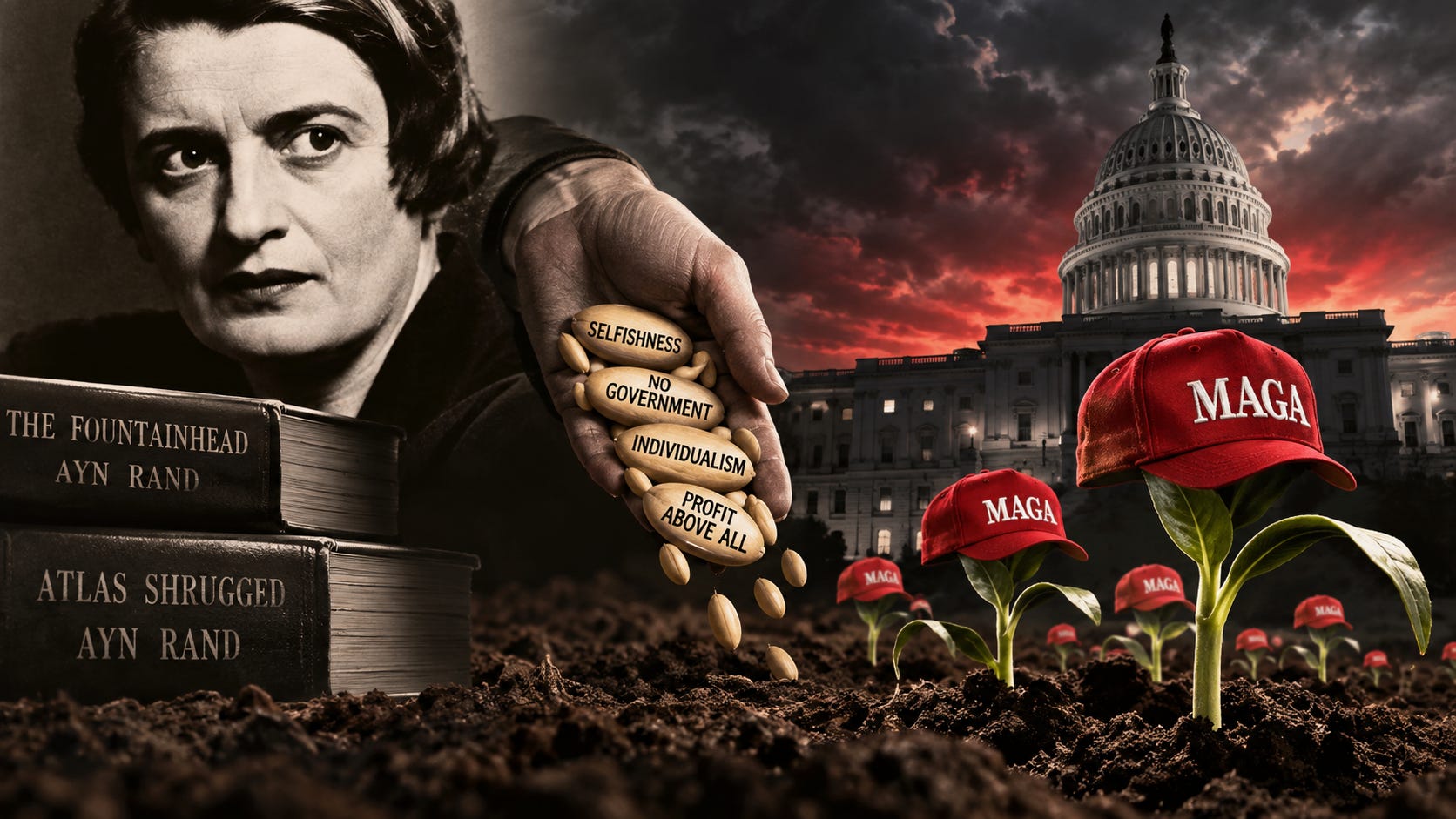
Reagan wasn’t just echoing the Libertarian vision; he was also endorsing Ayn Rand’s “Objectivist” view of the world, which traces its roots to a murderous psychopath in 1927.
Back in 2015, Donald Trump told USA Today’s Kirsten Powers that his favorite book was Ayn Rand’s raped-girl-decides-she-likes-it novel, “The Fountainhead.”
“It relates to business, beauty, life and inner emotions,” he told Powers. “That book relates to … everything.”
Ayn Rand’s novels have animated libertarian Republicans like former Speaker of the House of Representatives and current Fox News board member Paul Ryan, who required interns to read her books when they joined his staff.
Powers added, “He [Trump],” told her that he “identified with Howard Roark, the novel’s idealistic protagonist who designs skyscrapers and rages against the establishment.”
Rand’s hero Roark, in fact, “raged” so much in her novel that he blew up a public housing project with dynamite just to get what he wanted. Sort of like tearing down the East Wing of the White House and threatening to level the Kennedy Center.
Rand, in her Journals, explained where she got her inspiration for Howard Roark and so many of her other novels. She writes that the theme of The Fountainhead, for example, is:
“One puts oneself above all and crushes everything in one’s way to get the best for oneself.”
On Trump’s hero Howard Roark, she wrote words that Trump must have loved, saying that he:
“[H]as learned long ago, with his first consciousness, two things which dominate his entire attitude toward life: his own superiority and the utter worthlessness of the world. He knows what he wants and what he thinks. He needs no other reasons, standards or considerations. His complete selfishness is as natural to him as breathing.”
It turns out that Roark and many of her other characters were based on a real person. The man who so inspired Ayn Rand’s fictional heroes was named William Edward Hickman, and he lived in Los Angeles during the Roaring Twenties.
Ten days before Christmas in 1927, Hickman, a teenager with slicked dark hair and tiny, muted eyes, drove up to Mount Vernon Junior High School in Los Angeles and kidnapped Marion Parker — the daughter of a wealthy banker in town.
Hickman held the girl ransom, demanding $1,500 from her father — back then about a year’s salary. Supremely confident that he would elude capture, Hickman signed his name on the ransom notes, “The Fox.”
After two days, Marion’s father agreed to hand over the ransom in exchange for the safety of his daughter. What Perry Parker didn’t know is that Hickman never intended to live up to his end of the bargain.
The Pittsburgh Press detailed what Hickman, in his own words, did next.
“It was while I was fixing the blindfold that the urge to murder came upon me,” he said. “I just couldn’t help myself. I got a towel and stepped up behind Marion. Then, before she could move, I put it around her neck and twisted it tightly.”
Hickman didn’t hold back on any of these details: he was proud of his cold-bloodedness.
“I held on and she made no outcry except to gurgle. I held on for about two minutes, I guess, and then I let go. When I cut loose the fastenings, she fell to the floor. I knew she was dead.”
“After she was dead I carried her body into the bathroom and undressed her, all but the underwear, and cut a hole in her throat with a pocket knife to let the blood out.”
Hickman then dismembered the child piece-by-piece, putting her limbs in a cabinet in his apartment, and then wrapped up the carved-up torso, powdered the lifeless face of Marion Parker, set what was left of her stump torso with the head sitting atop it in the passenger seat of his car, and drove to meet her father to collect the ransom money.
He even sewed open her eyelids to make it look like she was alive.
On the way, Hickman dumped body parts out of his car window, before rendezvousing with Marion Parker’s father.
Armed with a shotgun so her father wouldn’t come close enough to Hickman’s car to see that Marion was dead, Hickman collected his $1,500, then kicked open the door and tossed the rest of Marion Parker onto the road. As he sped off, her father fell to his knees, screaming.
Days later, the police caught up with a defiant and unrepentant Hickman in Oregon. His lawyers pleaded insanity, but the jury gave him the gallows.
To nearly everyone, Hickman was a monster. The year of the murder, the Los Angeles Times called it “the most horrible crime of the 1920s.” Hickman was America’s most despicable villain at the time.
Ayn Rand falls in love with a “superman”
But to Alissa Zinovievna Rosenbaum, a 21-year-old Russian political science student who’d arrived in America just two years earlier, Hickman was a hero.
Alissa was a squat five-foot-two with a flapper hairdo and wide, sunken dark eyes that gave her a haunting stare. Etched into those brooding eyes was burned the memory of a childhood backlit by the Russian Revolution.
She had just departed Leninist Russia where, almost a decade earlier, there was a harsh backlash against the Russian property owners by the Bolsheviks. Alissa’s own family was targeted, and at the age of 12 she watched as Bolshevik soldiers burst into her father’s pharmacy, looted the store, and plastered on her Dad’s doors the red emblem of the state, indicating that his private business now belonged to “the people.”
That incident left such a deep and burning wound in young Alissa’s mind that she went to college to study political science and vowed one day she’d become a famous writer to warn the world of the dangers of Bolshevism.
Starting afresh in Hollywood, she anglicized her name to Ayn Rand, and moved from prop-girl to screenwriter/novelist, basing the heroes of several of her stories on a man she was reading about in the newspapers at the time. A man she wrote effusively about in her diaries. A man she hero-worshipped.
William Edward Hickman was the most notorious man in American in 1928, having achieved the level of national fame that she craved.
Young Ayn Rand saw in Hickman the “ideal man” she based The Fountainhead on, and used to ground her philosophy and her life’s work. His greatest quality, she believed, was his unfeeling, pitiless selfishness.
Hickman’s words were carefully recounted by Rand in her Journals. His statement that, “I am like the state: what is good for me is right,” resonated deeply with her. It was the perfect articulation of her belief that if people pursued their own interests above all else — even above friends, family, or nation — the result would be utopian.
She wrote in her diary that those words of Hickman’s were:
“[T]he best and strongest expression of a real man’s psychology I ever heard.”
Hickman — the monster who boasted about how he had hacked up a 12-year-old girl — had Rand’s ear, as well as her heart. She saw a strongman archetype in him, the way that people wearing red MAGA hats see a strongman savior in Donald Trump.
As Hickman’s murder trial unfolded, Rand grew increasingly enraged at how the “mediocre” American masses had rushed to condemn her Superman.
“The first thing that impresses me about the case,” Rand wrote in reference to the Hickman trial in early notes for a book she was working on titled The Little Street, “is the ferocious rage of the whole society against one man.”
Astounded that Americans didn’t recognize the heroism Hickman showed when he proudly rose above simply conforming to society’s rules, Rand wrote:
“It is not the crime alone that has raised the fury of public hatred. It is the case of a daring challenge to society. … It is the amazing picture of a man with no regard whatever for all that society holds sacred, with a consciousness all his own.”
Rand explained that when the masses are confronted with such a bold actor, they neither understood nor empathized with him. Thus, she wrote,
“[A] brilliant, unusual, exceptional boy [was] turned [by the media] into a purposeless monster.”
The protagonist of the book that Rand was writing around that time was a boy named Danny Renahan. In her notes for the book, she wrote, “The model for the boy [Renahan] is Hickman.” He would be her ideal man, and the archetype for a philosophical movement that would transform a nation.
“He is born with the spirit of Argon and the nature of a medieval feudal lord,” Rand wrote in her notes describing Renahan. “Imperious. Impatient. Uncompromising. Untamable. Intolerant. Unadaptable. Passionate. Intensely proud. Superior to the mob… an extreme ‘extremist.’ … No respect for anything or anyone.”
Rand wanted capitalism in its most raw form, uncheck by any government that could control the rules of the market or promote the benefits of society. Such good intentions had, after all, caused the hell she’d experienced in the Bolshevik Revolution.
Ayn Rand, like Hickman, found peace and justification in the extremes of her economic, political, and moral philosophy. Forget about democratic institutions, forget about regulating markets, and forget about pursuing any policies that benefit the majority at the expense of the very rich — the petty political rule-makers and rule-enforcers could never, ever do anything well or good.
Libertarianism and Ayn Rand set the stage for Trumpism
Only billionaires should rule the world, Trump has suggested.
And he tried to put it into place, installing a billionaire advocate of destroying public schools in charge of public schools, a coal lobbyist representing billionaires in charge of the EPA, a billionaire-funded oil lobbyist in charge of our public lands, and a billionaire described by Forbes as a “grifter” in charge of the Commerce Department. Trump’s former chief of staff said that putting children in cages and billionaire-owned privatized concentration camps (where 25 so far have died) would actually be a public good.
As Ayn Rand might say, “Don’t just ignore the rules; destroy them.”
Welfare and other social safety net programs were, as Rand saw it, “the glorification of mediocrity” in society. Providing a social safety net for the poor, disabled, or unemployed, she believed, were part of a way of thinking that promoted, “satisfaction instead of joy, contentment instead of happiness… a glow-worm instead of a fire.”
Psychopaths of the world, unite!
Rand, like Trump, lived a largely joyless life. She mercilessly manipulated people, particularly her husband and Alan Greenspan (who brought a dollar-sign-shaped floral arrangement to her funeral), and, like Trump, surrounded herself with cult-like followers who were only on the inside so long as they gave her total, unhesitating loyalty.
Like Trump, Patel, Musk, Vance, Kennedy, and their billionaire backers, Rand believed that a government working to help out working-class “looters,” instead of solely looking out for rich capitalist “producers,” was throwing its “best people” under the bus.
In Rand’s universe, the producers had no obligations to the looters. Providing welfare or sacrificing one nickel of your own money to help a “looter” on welfare, unemployment, or Social Security — particularly if it was “taken at the barrel of a gun” (taxes) — was morally reprehensible.
Like Trump saying, “My whole life I’ve been greedy,” for Rand looking out for numero uno was the singular name of the game — selfishness was next to godliness.
Rand’s philosophy, though popular in high school and on college campuses, never did — in her lifetime — achieve the sort of mass appeal she had hoped. But today Ayn Rand’s philosophy is a central tenet of today’s Republican Party and grounds the moral code proudly cited and followed by high-profile billionaires and three former presidents of the United States.
Ironically, when she was finally beginning to be taken seriously, Ayn Rand became ill with lung cancer and went on Social Security and Medicare to make it through her last days. She died a “looter” in 1982, unaware that her her promotion of William Edward Hickman’s sociopathic worldview would one day validate an entire political party’s embrace of a similarly psychopathic president.
The result so far is over a half-million Americans unnecessarily dead from Covid, an economy laid waste, another unending war, the destruction of America’s standing around the world, and the collapse of this nation’s working class.
While the ideas and policies promoted by the libertarian wing of the Republican Party have made CEOs and billionaire investors very, very rich in recent decades, it’s killing the rest of us.
A return to sanity
In the 1930s through the 1960s, Franklin Delano Roosevelt, Harry Truman, Dwight Eisenhower and JFK/LBJ put America back together after the First Republican Great Depression and built the largest and wealthiest middle class in the history of the world at the time.
Today, 45 years of Ayn Rand’s ideas being put into practice by libertarian Republicans from Reagan to Bush to Trump have gutted the middle class, made a handful of oligarchs wealthier than any kings or Pharaohs in the history of the world, and brought a whole new generation of predators, hustlers, and grifters into the GOP.
And then there’s Trump’s war against Iran, his theft of Venezuela’s oil and gold, his attacks on NATO and threats against Greenland, his cutting off weapons to Ukraine, his cashing in on the presidency in ways that clearly violate the Constitution, and his and the GOP’s multiple efforts to rig our elections.
There’s a popular meme going around the internet these days that says:
“If a monkey hoarded more bananas than it could eat while most of the other monkeys starved, scientists would study that monkey to find out what the heck was wrong with it. When humans do it, we put them on the cover of Forbes.”
If America is to survive as a functioning democratic republic, we must repudiate the “greed is good” ideology of Ayn Rand and libertarianism, get billionaires and their money out of politics, stop Trump and his lickspittles, and rebuild our civil institutions.
That starts with waking Americans up to the incredible damage that 45 years of Rand’s writings and libertarian “Reagan Republicans” have done to this country and giving Congress to Democrats who’ll actually investigate and prosecute these crimes against both democracy and our nation itself.
And that starts with checking your voter registration at vote.org and making a plan today to be sure your vote is both cast and counted.
Tag, we’re it!
Louise’s Daily Song: “Did Ayn Rand Plant the Seed?”
Comments on the Saturday Report:
Saturday Report 9/19/26 — Who Stole the American Dream...
A bigger problem than home heating oil, and there is not much of that left today is diesel.
The world runs on diesel, it drives the worlds navy’s, the merchant ships that haul petroleum and cargo containers, it powers the trains that deliver products from sea ports to your local store. It powers the trucks that deliver goods from wholesalers to retailers. The price of diesel is factored into the price you pay for milk, bread, eggs
~ William Farrar
Thom, this is what we have, when Putin is really running things here in our country. Thom, everybody in charge knows absolutely nothing about anything. This really is a time when we need smart, people to solve the serious problems, at hand now Thom! They are really dumb heads, all of them, Thom!
~ Jackie
Read the Article | See all Comments
Get the day’s news, both as a video and written report by Thom Hartmann, as well as a downloadable or an audio podcast, delivered right to your inbox every morning for free at CommonwealthReport.news:

Thom Hartmann’s Well-Read Troublemakers Book Club
The September book of the month is Looking Backward, From 2000 to 1887, by Edward Bellamy. Buy a copy or download it for free here.
This is a utopian science fiction novel published in 1888. When Julian West falls into a hypnotic sleep in 1887 Boston, he awakens 113 years later to find America transformed into a socialist utopia. Through conversations with his guide, Doctor Leete, West discovers a radically reimagined society where industry is nationalized, goods are equally distributed, and citizens retire at 45. This bestselling novel sparked a political mass movement and inspired over 162 discussion clubs across America.
Nearly all of the people I know who are self-proclaimed hardcore Republicans boast of being Ayn Rand fans. That serves to validate Thom's post today in my book.
Apart from being a homewrecker who banged another woman's husband from 1954-1968, Ayn was a pretty slick cultist . . . On the order of Jim Jones, without the cyanide-laced Flavor Aid [it was not Kool-Aid].
She is, post mortem, doing to the US middle class what that hero of hers did to his captive.
It seems the more horrific the life experience, the more horrific their fiction. Anthony Burgess wrote the novel "A Clockwork Orange" after his pregnant wife was sexually abused by 4 US GIs in 1944, during a London wartime blackout.
She lost the child and ultimately her life. Audiences got Kubrick's horror show.
We lose democracy and get Musk-Thiel-bought techno-fascism and Big Brother. Thanks a bunch, Ayn.
#VOTE to build a Presidential Wing of St. Elizabeth's, which opened in 1855 as the “Government Hospital for the Insane”, the first federally operated psychiatric institution in the United States.
#HOW did DT's seemingly healthy doctor kick the bucket so young? Dr. Harold Bornstein was Trump’s physician from 1980 to 2017 and died on January 8, 2021, at age 73. ... 73 ?!!!
#DRAIN all Kushner and Trump accounts. Note: Jared went begging for $ 5,000,000,000 more when he was supposed to be begging for peace in the Middle East.