

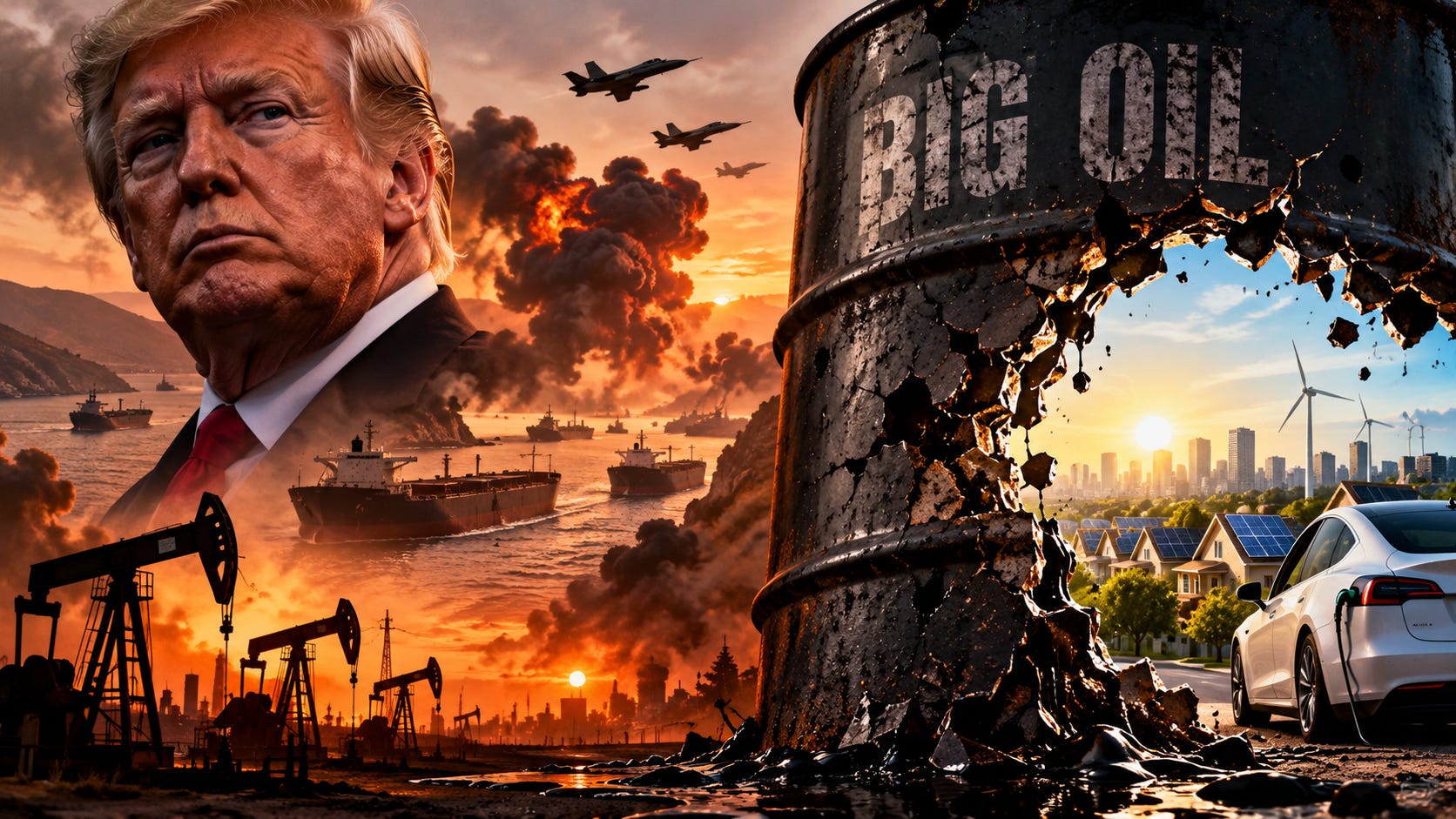
The price of oil has come down marginally this past week, largely because the Iranians are letting oil tankers transit the Gulf of Hormuz (presumably in an effort to work out a peace deal with Trump).
Meanwhile, though, the big lesson the world seems to have learned because of Trump’s fiasco — other than that our military is under the control of an irresponsible alcoholic and a narcissist and unreliable wannabe king — is that it’s high time to get off fossil fuels.
Starting a stupid and criminal war is probably the dumbest way to wake the world up to the need to kick their/our collective addiction, but here we are: the war has done more to encourage conservation and the transition to renewables than any other single effort by anybody anywhere in recent memory.
A new report from the International Energy Agency found that global demand for oil has fallen 2.5 percent this year, the equivalent of taking 42 million gas-burning cars off the road.
I’ve been watching all this from an odd vantage point. Three years ago we put solar panels and batteries on our all-electric house, where our winter electric bills had been running as high as $500 a month.
Now, the only time we buy electricity at all is in the dead of winter, and even then it costs a fraction of what it used to because I can download power at night when it’s cheapest. Between that and having an electric car I charge off my rooftop, energy prices exploding because of Trump’s and Bibi’s war haven’t much affected us directly.
But such benefits shouldn’t be limited to people who can afford to put solar panels on their roofs and live in Blue states with huge solar subsidies. Every American should have such an option.
I first understood how this could work for an entire country back in September of 2009, when I was invited to join German Member of Parliament Hermann Scheer as a keynote speaker at a conference at the Centre de Cultura Contemporània de Barcelona.
Almost a decade earlier, Scheer had shepherded his “100,000 Rooftops” program through the German Parliament and was eager to talk about how it worked and how it could work in Spain. As he laid out the concept to me over lunch, it was simple and elegant.
Banks would loan people the money to put rooftop solar on their houses at a super-low interest rate, with defaults backstopped by the government so there was no risk to the bank and they could make money on a super-low-interest loan. Power utilities would buy surplus power from those homes at a “feed-in tariff” rate that was higher than the retail price of electricity until the bank loans were paid off, typically in five to ten years.
The rates were set so that if the monthly loan payments on your rooftop system were $100, the local utility would be paying you around the same $100 a month. When the loan was paid off you’d own a solar system that would last for decades, and you’d have gotten it for free.
The extra expense to the utilities for those payments to consumers would still cost less than building a new power plant. The system let the Germans decommission a few and avoid building any new nuclear plants.
Politics intervened, of course, and the program wasn’t implemented as cleanly as Scheer described it to me, but it got a long way there, even though he died the following year at just 66. Today well over a million German homes have both solar panels and battery storage, and solar covers around 14 percent of the country’s electricity, all of it in the cloudiest country in Europe at the same latitude as Calgary, Canada.
And the rest of the world is following following at a faster and faster rate. The IEA now expects electric vehicles to make up a record 29 percent of all the cars sold on Earth this year, with sales records set in 50 countries last quarter as fuel prices from Trump’s war pushed drivers away from gasoline and diesel.
In the European Union overall, EVs are now more than 30 percent of sales and over 50% in China; they’re nearly 100% of sales in some countries like Norway. Here in America they’re just a pathetic 5.8 percent this year.
What explains the growing enthusiasm for electric cars around the world and here in America is, in large part, the price of fuel.
For a century in America the price of oil and its refined products has left out most of what they truly cost us. It doesn’t include the cancers and the asthma, the wildfires and the floods, or the wars we fight to keep tankers moving through places like the Strait of Hormuz.
Economists call these externalities, and the International Monetary Fund puts the worldwide total at $7 trillion a year in costs — subsidies, really — that the fossil fuel industry hands off to the rest of us. As I laid out in The Last Hours of Ancient Sunlight, we’ve been burning through millions of years of stored sunlight as if it were free of any real costs or externalities.
We figured out how to handle this problem of paying for externalities and discouraging destructive behavior long ago with alcohol and tobacco, which we tax heavily both to discourage their use and to pay for some of the damage they do to our individual health and to our society.
Europe has taxed fuel that way for decades. Germans pay upwards of three dollars a gallon in fuel taxes, while our federal gas tax has been stuck at 18.4 cents since 1993.
And you can see the results in any European town: people drive smaller cars and fewer miles, they take the train, and because driving is expensive they walk to the bakery and the hardware store down the street, which also has the added benefit of boosting Europeans’ health while keeping their money circulating in the local economy.
A high price cuts consumption whether it comes from a war or from a tax, but what separates the two is where the money ends up.
— When a war drives up the price of oil, the extra dollars flow to fossil fuel companies and dictatorial petrostates as windfall profits.
— When a tax does it, the money belongs to us. It can go right back to working families as a rebate check or EV subsidy, and it can pay for the kind of loan guarantees that put solar on all those German roofs.
Europe is now extending the principle to trade with a carbon charge at its border, which is the closest the world has yet come to the international price on carbon we need to make it reflect the very real damage it’s doing to our lives and environment.
None of this is happening here in the United States, however, because of the Republican Party’s Faustian bargain with the fossil fuel industry.
Reagan took Jimmy Carter’s solar panels off the White House roof to make his oil industry donors happy, and every Republican administration since has handed our public lands and resources to the industry at giveaway prices while the industry pours money into gifts, trips, and Republicans’ campaigns.
Trump made the deal explicit at Mar-a-Lago in 2024 when he asked oil executives for a billion dollars and promised to gut our climate rules in return, a promise he’s kept by killing the wind, solar, and EV incentives that would’ve let millions of American families do what we did with our house and car (both bought and installed with credits from the Obama administration and our enlightened Oregon state government).
So when the price of gas and diesel begins to fall back and Trump and the GOP start taking credit, remember what this year proved: Instead of subsidizing fossil fuels to jack the profits of the companies that fund the GOP, we should be taxing them the way Europe does and using that money to turn every American roof into a power plant.
Call your members of Congress through the Capitol Switchboard at 202-224-3121 and tell them you want fossil fuels priced at what they really cost us and rooftop solar financed the way Germany did it.
And if you found this useful, please share it with your friends and family and consider subscribing to and supporting the Hartmann Report, because reader-supported media is how ideas like these get past the industry’s wall of money.
Louise’s Daily Song: “Did Trump’s Iran War Just Blow a Hole in Big Oil’s Future?”
Comments on Thursday’s Daily Take:
Trump’s $500 Checks Reveal the GOP’s “Billionaire Theory of Democracy”: Everything Has a Price
Democracy was gradually undermined when corporations became people, money became speech, and petitioning the government became professional lobbying. Accepting money in exchange for one’s principles is the logical absurdity that leads to mobster government.
~ Jeffrey Hobbs
$500 or $5000 checks - it’s all bribery. “High crimes, BRIBERY, Misdemeanors. Ordering a war is a high crime. There are thousands of misdemeanors.
~ US Taxpayer
Read the Article | See all Comments
Get the day’s news, both as a video and written report by Thom Hartmann, as well as a downloadable or an audio podcast, delivered right to your inbox every morning for free at CommonwealthReport.news:

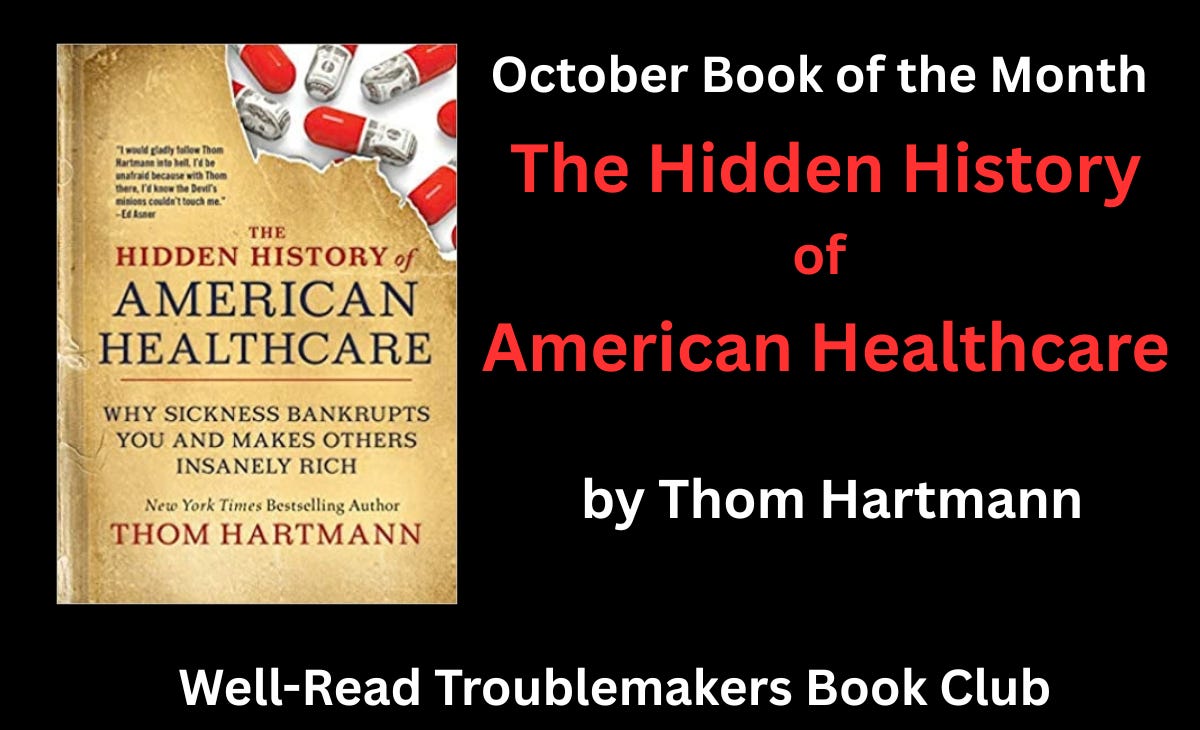
Thom Hartmann’s Well-Read Troublemakers Book Club
The October book of the month is The Hidden History of American Healthcare, by Thom Hartmann. Buy a copy Kindle edition.
”Why Sickness Bankrupts You and Makes Others Insanely Rich”.
Other countries have shown us that affordable universal healthcare is not only possible but also effective and efficient. Taiwan’s single-payer system saved the country a fortune as well as saving lives during the coronavirus pandemic, enabling the country to implement a nationwide coronavirus test-and-contact-trace program without shutting down the economy. This resulted in just ten deaths, while more than 500,000 people have died in the United States.
With solar and wind, for the first time in human history, we are creating energy without burning something, and without human or animal muscle. that would be a revolutionary development in civilization. Predictably, though, the party of protecting Neanderthal petro-privilege want to keep us suffocating in our own deadly pollutants.
I wish Michael Ruppert had lived to see this. 12 years later all his warnings and predictions are coming true.