

While Americans were celebrating this Labor Day weekend, in Magdenburg, Germany a 35-year-old neofascist, Ulrich Siegmund, told a cheering crowd that his rightwing Alternative für Deutschland party was “taking our country back.” They’d just pulled 44 percent of the vote in the German state of Saxony-Anhalt, double what it’d been just five years ago.
Their platform was simple: expel brown-skinned immigrants, dump the EU and NATO to instead build an alliance with Russia, and tear up the tech, climate, and energy rules so the fossil fuel and tech billionaires could take over Germany’s government like they are America’s under Trump.
It was a stunning victory for Vladimir Putin, Elon Musk, and Donald Trump, who all went online (Putin through spokesman Kirill Dmitriev) and immediately congratulated the heirs to Hitler’s party on their showing in the election.
That same weekend, Fareed Zakaria aired a conversation with Chrystia Freeland, Francis Fukuyama, and David French about why liberal democracy is in retreat, and Freeland argued that China’s so-far-successful model of state-directed capitalism is the biggest threat to democracy around the world.
And there’s a lot of truth in that, since China’s success proves that capitalism doesn’t need democracy to flourish and, in fact, may do even better in an authoritarian state like modern China and 1930s Germany.
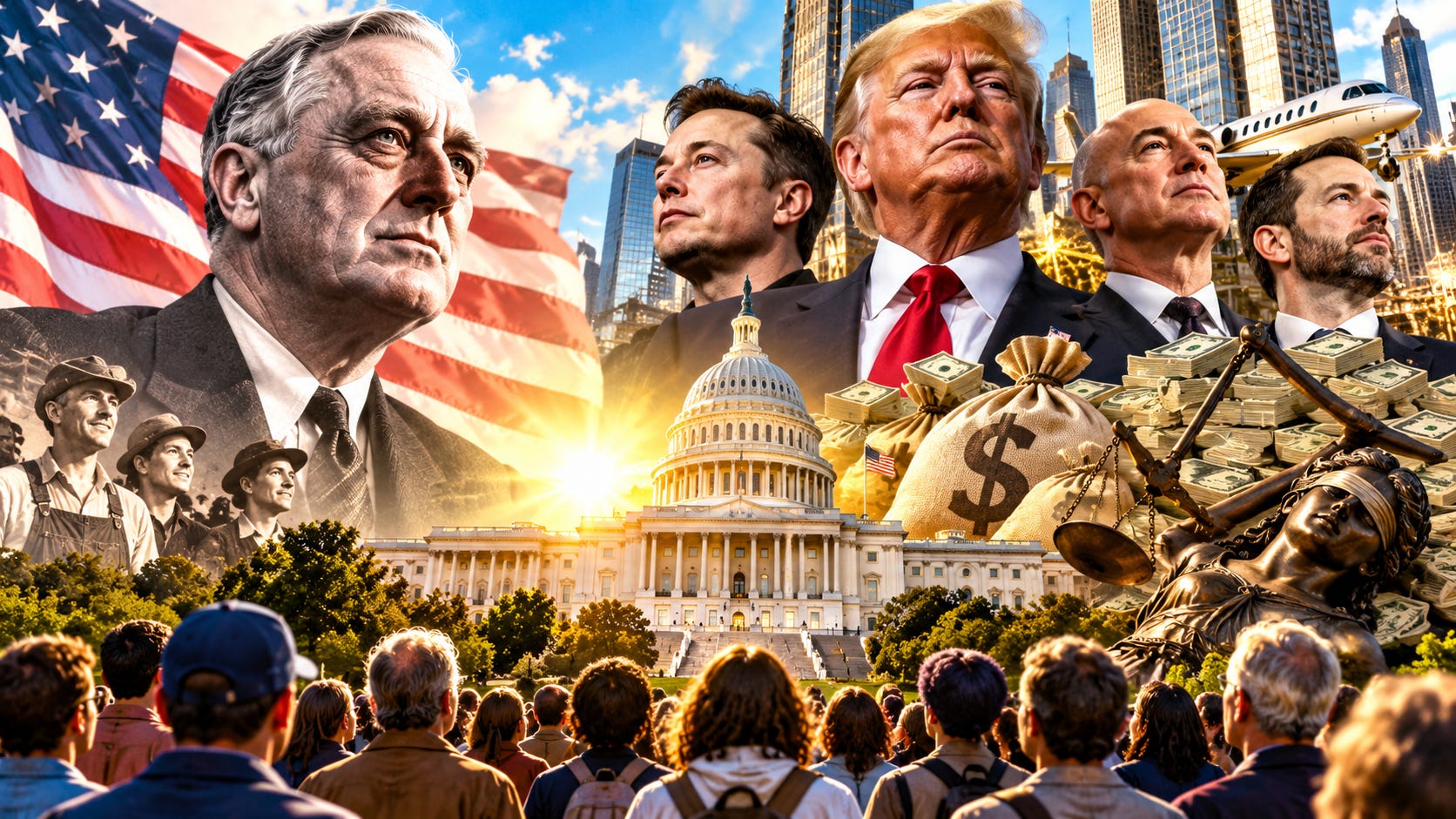
But the most serious threat to American democracy isn’t coming from Beijing; it’s coming out of Wichita, Silicon Valley, Mar-a-Lago, and from Republicans in black robes who’ve been taking gifts from billionaires for years. Here’s why.
At the end of the day, capitalism is just a game we play, which is why pro football is such a good analogy. Football is a phenomenal engine for producing it’s goal — entertainment — and it works because there are rules, referees who enforce them, and a league that ruthlessly punishes cheaters.
But imagine a Trump-run NFL announcing that whichever team wrote the biggest check to the league’s head guy could put fourteen men on the field, pull face masks, and throw kidney punches with no flags. The richest team would win every game, the entertainment value would ultimately collapse, and within a few seasons the game itself would be dead.
Capitalism is exactly that kind of engine. Since Deng Xiaoping opened China to markets in 1978, according to the World Bank, growth of the Chinese economy has averaged over nine percent a year, lifting nearly 800 million people out of extreme poverty, the largest reduction of human misery in recorded history.
I spent the month of November, 1986 in Beijing studying acupuncture; the city was poor, the air choked with coal smoke, and capitalism was just getting off the block with experimental “special economic zones” like Shenzhen. Nobody voted for it; China was then and is now essentially a totalitarian state, proving that capitalism doesn’t need democracy to be successful.
As the Chinese figured out in the 1970s when they rejected Reagan’s neoliberalism and instead embraced state-run capitalism (I wrote about this at length in The Hidden History of Neoliberalism: How Reaganism Gutted America), in order to work well and produce general prosperity, capitalism just requires rules that prevent the most successful capitalists from rising up and taking over the state (as is happening here).
For example, when China’s richest man (Jack Ma) started complaining in 2020 that government regulators were holding his companies back from maximum profitability, the Chinese government killed off Ma’s Ant Group’s IPO and fined his Alibaba $2.8 billion for the monopolistic behavior of forcing merchants into exclusive contracts. Ma himself vanished from public view for a few months while he was “rehabilitated.”
I’m no admirer of a one-party state, and I’d never want to live under one. But the Chinese Communist Party figured out more than fifty years ago — from watching the failures in our example — that if you let the winners of capitalism write the rules of capitalism, they’ll first destroy the competition and then come for the government that hosts them.
They instead regulated their billionaires and their companies, in other words, because they knew what unregulated billionaires typically do to whoever’s in charge.
We Americans once understood that, and had a president who spoke about it in simple, straightforward terms.
President Franklin D. Roosevelt came into office in 1933 to clean up the GOP’s mess of the Republican Great Depression; he fought back against his generation’s oligarchs, declaring in 1936:
“For out of this modern civilization economic royalists carved new dynasties. New kingdoms were built upon concentration of control over material things. …
“It was natural and perhaps human that the privileged princes of these new economic dynasties, thirsting for power, reached out for control over Government itself.”
FDR took on those “economic royalists” and defeated them. He explicitly called them out when the Democratic Party renominated him for president in 1936 in Philadelphia:
“These economic royalists complain that we seek to overthrow the institutions of America. What they really complain of is that we seek to take away their power.”
He paused for a moment, then thundered, “Our allegiance to American institutions requires the overthrow of this kind of power!”
The crowd roared, delighted that he’d put millions to work while stripping that day’s oligarchs of their power. And he raised the top tax rate on the morbidly rich back up to 90 percent, while stopping an effort to kidnap him and turn our government fascist.
“In vain,” Roosevelt said, “they seek to hide behind the Flag and the Constitution. In their blindness they forget what the Flag and the Constitution stand for. Now, as always, they stand for democracy, not tyranny; for freedom, not subjection; and against a dictatorship by mob rule and the over-privileged alike.”
Four months later at Madison Square Garden FDR named the forces of “monopoly, speculation, and reckless banking,” said they were “unanimous in their hate” for him, and told the crowd he welcomed their hatred.
He wasn’t trying to abolish capitalism. He was putting it back under control of the people’s rulebook: Glass-Steagall, the SEC, the Wagner Act, antitrust enforcement, a minimum wage, and a top tax rate of 90%.
Republicans fought it all, calling it “socialism” in increasingly hysterical tones, but it worked and FDR put America back together and built the world’s first middle class that was more than half of a nation’s people.
The American oligarchs of that era, in response, pulled out of politics and went back to just doing business and getting rich, until Nixon put Lewis Powell on the Supreme Court and Powell began the process — from the bench — of turning America into a full-blown oligarchy.
During FDR’s era, fascism had risen out of the ashes of the Republican Great Depression, sweeping in a few short years across Italy, Germany, Austria, and Spain.
History tells us that when ordinary people are forced to watch the rich buy their government and that government then fails to sustain them, they lose faith in democracy long before they realize it was actually unregulated capitalism that screwed them.
Invariably, that’s when a strongman shows up promising to “take their country back,” and they cheer.
Roosevelt’s answer was to make democracy deliver for the working people, and to make the morbidly rich pay for it. And it worked: over the next forty years America built the largest middle class the world had ever seen.
I’ve spent most of my adult life inside capitalism; over the past fifty-five years Louise and I have started and run five small businesses. Not once in all those years did we go to a politician with a wad of cash and ask him to change the rules so we could get richer. We were working under FDR’s rules.
Then along came the fossil fuel billionaires funding Reagan, and it all changed in a single generation. The Powell Memo laid out the plan in 1971, and Fred Koch’s sons, along with Coors, Scaife, Olin, Murdoch, and Bradley built the think tanks, the media, and captured the university chairs to indoctrinate the next generation.
What Reagan added was a new sales pitch Americans hadn’t heard before: government is the problem, the rules are the enemy, and your real opponent is the Black family down the street or the woman you think took your promotion.
In one fell swoop, the richest men in America dismantled four decades of FDR’s restraints and taxes while working people argued with each other about whether Reagan’s reviled “union bosses,” immigrants, “welfare queens,” or queer people were responsible for their troubles.
Then in 2010 the five corrupt Republican appointees on the Supreme Court handed down Citizens United and told the billionaires they could buy American democracy’s referees openly. Several of those justices, we later learned from ProPublica, had spent years accepting undisclosed yacht cruises, private jets, and luxury vacations from billionaire donors with business before the Court while John Robert’s wife took millions from the same law firms that argued in front of her husband.
The result of this “football game” being corrupted by America’s capitalists is measurable. In the 2024 election, just 100 billionaire families spent $2.6 billion on federal races, one of every six dollars spent by anyone, and roughly 160 times what billionaires spent before Citizens United.
Virtually all of that money went to support Republican candidates who are back to Reagan’s old trick of blaming the middle class’ ills on the poorest and least powerful among us while jacking trillions into the money bins of Zuck, Musk, Trump, and Bezos.
Musk alone put up $278 million, then got handed the keys to the federal government so he could shut down investigations into himself and his businesses. And the man who moved JD Vance from obscure writer to vice president, Peter Thiel, wrote in 2009 that he no longer believed freedom and democracy were compatible, a perspective both Putin and Xi heartily endorse.
These men aren’t confused about how they’re trying to transform America: they’ve watched Chinese state-run capitalism produce vast wealth without elections and concluded, correctly, that the elections were the unnecessary part, if only the people can be sufficiently intimidated or brainwashed.
Europe’s been running this same neoliberal experiment since the Reagan/Thatcher 1980s, and Saxony-Anhalt is its poster child. Decades of privatization, austerity, and deregulation left eastern Germans feeling that the government in Berlin had forgotten about them.
Into that void came a party whose leading figures have been under investigation for taking money from a Kremlin-linked influence network and whose richest cheerleader lives in Texas and controls the social media outlet that was arguably largely responsible for AfD’s success.
When Putin took over the new, fragile Russian democracy at the beginning of this millennium, his first job was to get control of the oligarchs who largely owned the economy. He killed some, imprisoned others, and made those who’d swear total loyalty and fealty to him richer than Midas.
Trump appears to be following that same plan, which is why America’s oligarchs are beating a path to his door, bearing gifts.
Democracy not only isn’t necessary in the minds of these “new Republicans”; it’s there to be bought-and-sold, bent to their will with billions spent on elections and propaganda, and ultimately turned against itself to create an authoritarian surveillance state of, by, and for the wealthiest capitalists.
Regulation is capitalism’s immune system and works for an economy the same way the NFL’s rules work for that game. Antitrust laws, campaign finance limits, financial transparency rules, and progressive taxation keep the richest teams from “buying the league” and corrupting the entire system.
Roosevelt understood that the “privileged princes” would always reach for control over government, and that the only defense was a government strong enough to say no. We had that for forty years, from the 1930s to the 1980s.
We can have it again, but only if the people who benefit from an honest game outvote the followers of the billionaires like Trump and Musk who’ve been paying to rig it.
We need a constitutional amendment overturning Citizens United like I detail in Who Killed the American Dream?, real antitrust enforcement, free or low-cost healthcare and college for the middle class, more widespread unionization, rational immigration reform, and a return to high taxes on the morbidly rich: all programs the billionaires and their lickspittle elected Republicans oppose.
Check your registration at vote.org and find out who’s running for your state legislature at openstates.org, because the rulebook gets rewritten in statehouses too.
And if you found this useful, please subscribe to and share the Hartmann Report, because independent media that isn’t owned by a billionaire is also a major part of democracy’s immune system.
Tag, we’re it.
Louise’s Daily Song: “FDR’s Darkest Warning Was Right”
Comments on Monday’s Daily Take:
Has the Media Normalized the GOP’s Voter Suppression Right Before Our Very Eyes?
Not sure I believe Greg Palast’s stance on the ‘24 election, but who knows? It’s possible! Certainly, Repubs have been using sleazy methods to ensure college students & minorities don’t get to vote for decades now. It is pathetic how legacy media has covered this so poorly.
~ Nancy Bruski
Gawd, this makes my blood boil! Like you, I’ve mostly voted in the mainly-white suburbs. I always thought those long lines were due to unprecedented numbers of voters flooding their precincts! To learn that it’s a voter suppression technique is INFURIATING!!! This regime cannot be voted out and charged with felonies soon enough for me.
~ Dian Allison
Read the Article | See all Comments
Get the day’s news, both as a video and written report by Thom Hartmann, as well as a downloadable or an audio podcast, delivered right to your inbox every morning for free at CommonwealthReport.news:

Thom Hartmann’s Well-Read Troublemakers Book Club
The September book of the month is Looking Backward, From 2000 to 1887, by Edward Bellamy. Buy a copy or download it for free here.
This is a utopian science fiction novel published in 1888. When Julian West falls into a hypnotic sleep in 1887 Boston, he awakens 113 years later to find America transformed into a socialist utopia. Through conversations with his guide, Doctor Leete, West discovers a radically reimagined society where industry is nationalized, goods are equally distributed, and citizens retire at 45. This bestselling novel sparked a political mass movement and inspired over 162 discussion clubs across America.
Thom's post was a BINGO! Back when I was a military officer and civil servant, I gave occasional guest lectures at Dresden Technical University and did some consulting to help the Saxon government struggle to transition to democracy back in the early 90s. One thing that Thom did not touch on, but which likely explains the rise of the AfD is the economy.
The Soviets did very little to help support the post-war economy in the Saxon capital of Dresden (https://en.wikipedia.org/wiki/Bombing_of_Dresden). I recall a huge mansion at the end of (If I recall correctly) the Augustusbrücke across from the royal side of the Elbe. In 1991, there was a mature tree growing right through the bombed-out roof. It is finally gone today, but it was clear evidence that Russia did the minimum to restore what WWII westerners bragged was a mass bombing campaign to flatten the city to end the war. So, when the Wall came down, Saxony was still a postwar mess.
Sadly, Saxony was not getting much recovery help from Germany. While the capital, Dresden, slowly recovered, the rest of the state economically resembled the post-Civil War South in America. The transition from agriculture to manufacturing was slow. Chemnitz especially resented the lack of recovery support. Kruschev had implemented RFKjr-type babushka agricultural policies that destroyed the fertility of fields, such as eliminating all tree lines (windbreaks) which led to erosion so bad that crop yields fell and took decades to restore. The farm ponds were so polluted with fertilizer and insect spray chemicals that the livestock were dying off. The result today is that Saxony shares an economy and political worldview similar to Louisiana.
Democracy has to be both political and economic in order to maximize freedom. When capitalists talk of freedom, they mean freedom for themselves alone, not for their workers; freedom from taxation, regulation, responsibility, and consequences. Their only object is profit; all that flag-waving and freedom talk is just a joke they play on us. When we democratize, we socialize, by creating and ensuring the fairest and broadest possible distribution of power.