For over 50 years, our media has been covering up Republican voter suppression efforts. This year, though, they’re getting so obvious that it’ll be interesting to see if they continue to whitewash the practice.
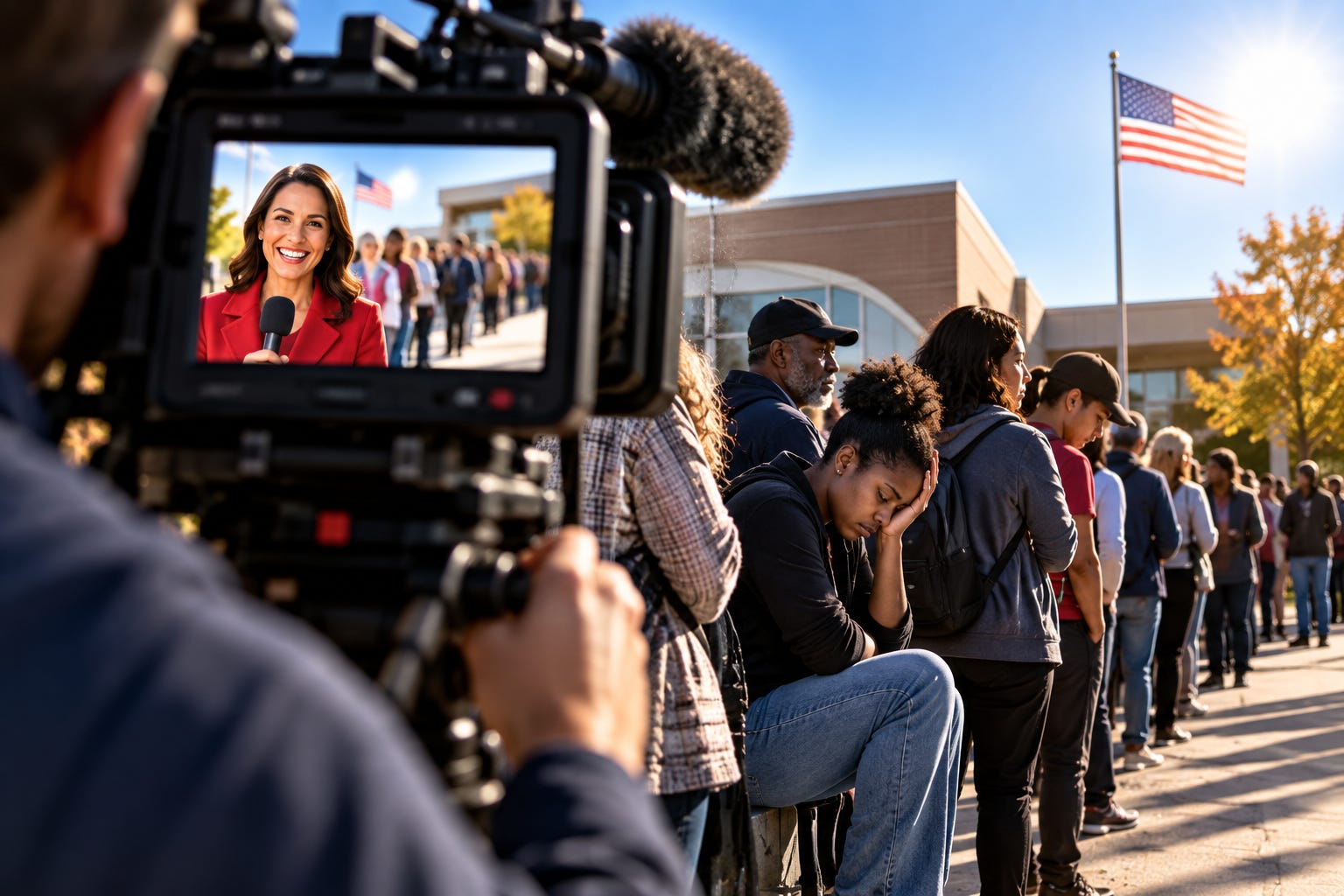
Remember all those reports you’ve seen on TV during previous elections, where the reporter is outside a polling place with a line stretching around the block?
In the 2008 election, for example, CNN anchor Kirin Chetry noted that in Ohio:
“It was, after all, 120,000 votes that made the difference in that state in 2004 and gave the win to now President Bush.”
Republicans controlled the voting in Ohio, so they rigged polling places so people in mostly-Black, Hispanic, and student areas would have to wait hours and hours in line to vote, knowing that these were also the people most likely to be paid hourly and so would be unwilling to stand in line for hours to vote.
Here’s how it played on CNN from their November 4, 2008 transcript:
“MARY SNOW, CNN CORRESPONDENT: Yes, Kiran, certainly, around Ohio, board of election officials are bracing for long lines. And this is because the state is expecting record turnout, 80 percent of Ohio’s voters are expected to turn out and about a quarter of the voters vote early.
“And, of course, we’ve been seeing those long lines over the last several days in Columbus where voters had to wait several hours to cast a ballot, but for the most part, people were in good spirits. And the enthusiasm outweighs the frustrations.”
No mention that this is the #1 voter suppression technique that Republicans have been using in the states they control ever since the 1960s.
In that election, lines in Black neighborhoods in Republican-run Georgia ran eight to ten hours, four hours in Blue parts of Republican-run Florida, and the same in Democratic strongholds in Republican-run Virginia. As CNN’s Campbell Brown reported:
“Take a look at this. Early voting lines around Atlanta today were two, four and at times even 10 hours long, pretty maddening. And, unfortunately, for the impatient among us, it’s been the same in some of the other early voting states as well. But don’t let that dampen your enthusiasm.”
Nobody bothered to mention that the long lines are almost entirely in heavily-Democratic precincts. I’ve been voting since I was 18 — including a decade in Georgia — but have always lived in mostly-white mostly-upper-middle class neighborhoods so I’ve never waited more than 15 minutes to vote.
But the media seems to consistently miss that disparity or the reason Republicans always set it up, instead telling the stories of “brave” voters so “dedicated” to democracy that they’ll stand in line for hours.
Here’s the Washington Post on election day, 2012 from 40% nonwhite Arlington, Virginia, whose elections were controlled by a State Board of Elections appointed by Republican Governor Bob McDonnell:
“At 8 a.m., in Arlington, Va., 644 people were lined up outside an apartment building polling station, almost all of them late for work. ‘I’m glad to see everyone out, it doesn’t matter who they’re voting for,’ said Emma Durazzo, 84, who works at the Pentagon and, in 28 years in the neighborhood, has never seen lines like this on Election Day.”
In previous elections going back to 2002, Democrats (Governors Mark Warner and Tim McCain) had run the elections in Virginia.
Pew and the Massachusetts Institute of Technology (MIT) did an in-depth analysis after the 2012 election and found that nationally 20% of Black voters and 17% of Hispanic voters reported waits exceeding 30 minutes, versus 11% of white voters.
The Brennan center found that Black voters typically waited 45% longer in line than white voters, and Latino voters waited 46% longer.
As Beto O'Rourke notes about what happened when John Roberts and his corrupt Republican colleagues on the Supreme Court destroyed the Voting Rights Act:
“Within minutes of the decision, Texas imposed the most restrictive voter ID law in the country, disenfranchising more than 600,000 citizens who, all of a sudden, couldn’t meet the state’s standard for proving who they were. Over the decade that followed Texas also closed more than 700 polling places, twice the number of the next most restrictive state, and almost all of them in African American and Latino neighborhoods. Congressional districts were racially gerrymandered, voting by mail was restricted and voting locations were moved miles away from colleges and universities.
“Without the protection of the Voting Rights Act, politicians were free to not only pick their voters, but they could now choose who could vote in the first place.”
While this may be a secret to the media and most white voters, Republicans are very, very clear about their favorite voter suppression strategy. Just look at what they did last week in Texas’ Tarrant County, where the 1.2 million voters are 60% nonwhite.
With 316 voting locations, the county experienced long lines in the 2020 presidential election, as CBS Dallas/Fort Worth reported. They noted:
“Bill and Dee Horn waited two hours, but said it was well worth it. Now in their 60s, they say they’ve voted in every presidential election since they were 18.”
But the lines in this increasingly blue area weren’t long enough for the Republicans who control the Commissioner’s Court that determines how many voting locations there will be and where. They cut out 92 of those polling places, virtually all of them in minority or student areas.
When people have to stand in line for six hours to vote in Tarrant County this November, will the media cover it the way ABC/Channel 11 in Republican-controlled North Carolina did?
“At University City library in Charlotte, lines were two hours long Thursday morning and growing. Some standing in line said they were ready for the election to end.
“‘Voting is the equivalent of the shower we all needed after the three (presidential) debates,’ said Gregory Weeks, chairman of the UNC Charlotte political science department, who waited two hours to cast his ballot.
“Back in Raleigh, Mitchell said she didn’t mind waiting in line.
“‘It’s important,’ she said, ‘and I’m happy to get the chance to do it.’”
During the Jim Crow era, conservatives used a wide array of strategies to prevent Blacks and other minorities (and often women) from voting, including guessing the number of jelly beans in a jar, so-called literacy tests, requiring the recitation of part of the Constitution from memory, poll taxes, etc.
When these were all outlawed with the 1965 Voting Rights Act, Republicans shifted their strategy to creating long lines, purging people from voting rolls, and challenging signatures on mail-in ballots.
In the first national election after the Act’s passage, for example, the only precinct in Tallulah, Louisiana that was majority Black ended up with one single polling place for roughly 1,400 voters. When it opened at 6 a.m., approximately 600 people, virtually all Black, were already standing in line.
The newly-created US Commission on Civil Rights concluded, as Black aldermanic candidate Zelma Wyche said:
“[B]ecause of the long wait, many Negro voters…tired of waiting and went home without casting ballots.”
When reporter and former statistics professor Greg Palast went through official government numbers from the 2024 election, he found that Republican voter suppression won the day for Trump and the GOP, just as it had for George W. Bush in Florida in 2000 and Ohio in 2004:
“Trump lost. That is, if all legal voters were allowed to vote, if all legal ballots were counted, Trump would have lost the states of Wisconsin, Michigan, Pennsylvania and Georgia. Vice-President Kamala Harris would have won the Presidency with 286 electoral votes.
“And, if not for the mass purge of voters of color, if not for the mass disqualification of provisional and mail-in ballots, if not for the new mass ‘vigilante’ challenges in swing states, Harris would have gained at least another 3,565,000 votes, topping Trump’s official popular vote tally by 1.2 million.”
And that doesn’t even begin to count all the people who simply gave up and went back to work after standing in line for an hour or two.
You can bet that if Democratically-controlled Blue states had been shorting voting machines and polling places in upscale white Republican areas, the GOP’s squeals could be heard halfway around the world. It would be an epic scandal, and the media would cover it as such.
This fall, how will they cover the long lines and outraged voters who show up only to discover they’ve been purged from the rolls by Republican secretaries of state? Stay tuned…
Louise’s Daily Song: “Will the Media Finally Ask?”
Comments on the Saturday Report:
Saturday Report 9/5/26 — Putin tests NATO’s patience, Milei tests Britain’s, and John Fetterman tests whether there’s a floor beneath which a Democratic senator can sink…
What, a country we have now Thom. A token of their appreciation, I’m sure. Our, country is a laughing stock. for what Thom. That sucks.
~ Jackie
American foreign policy is so uniquely awful that it will prop up a flailing, scorched-earth ignoramus in Argentina because he welcomes corporate patronage, but will bend every effort to take down a communist regime in Cuba (and did take down and colonize Venezuela),because they insist on their political and economic sovereignty over US interests. The same corporate imperialism and ethno-bigotry poisons our approach to the Middle East, Africa, etc. etc.
~ Jeffrey Hobbs
Read the Article | See all Comments
Get the day’s news, both as a video and written report by Thom Hartmann, as well as a downloadable or an audio podcast, delivered right to your inbox every morning for free at CommonwealthReport.news:

Thom Hartmann’s Well-Read Troublemakers Book Club
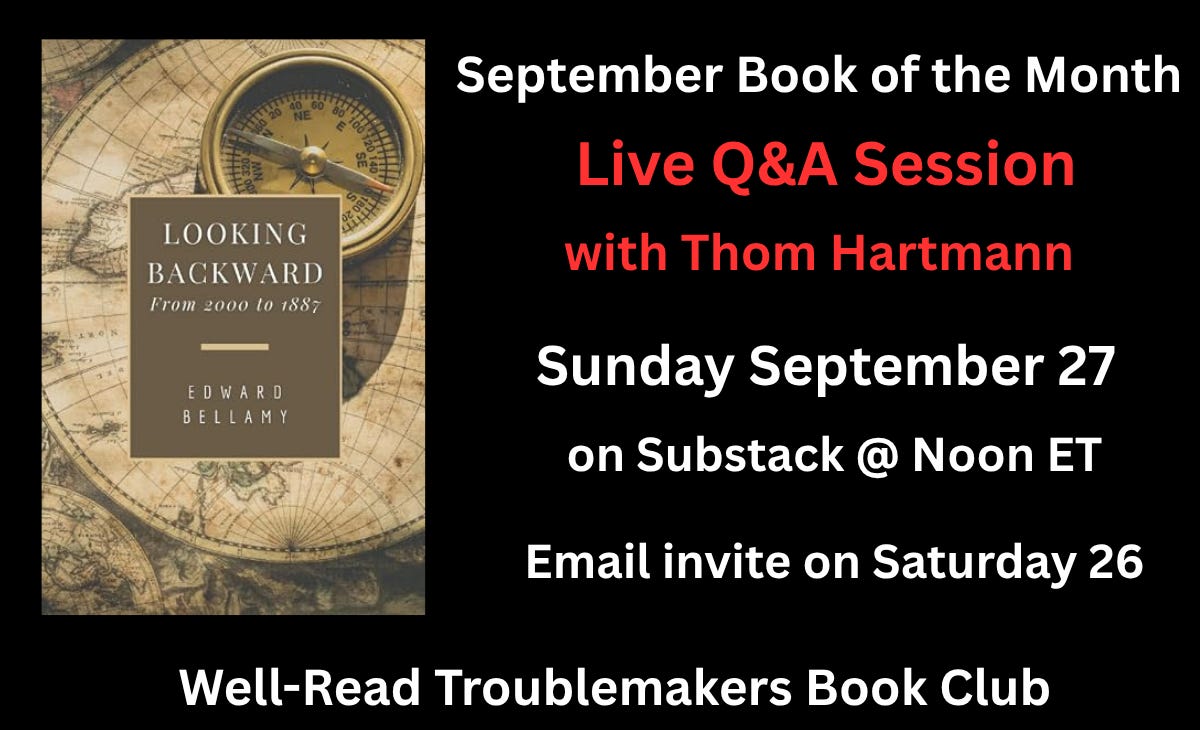
The September book of the month is Looking Backward, From 2000 to 1887, by Edward Bellamy. Buy a copy or download it for free here.
This is a utopian science fiction novel published in 1888. When Julian West falls into a hypnotic sleep in 1887 Boston, he awakens 113 years later to find America transformed into a socialist utopia. Through conversations with his guide, Doctor Leete, West discovers a radically reimagined society where industry is nationalized, goods are equally distributed, and citizens retire at 45. This bestselling novel sparked a political mass movement and inspired over 162 discussion clubs across America.