

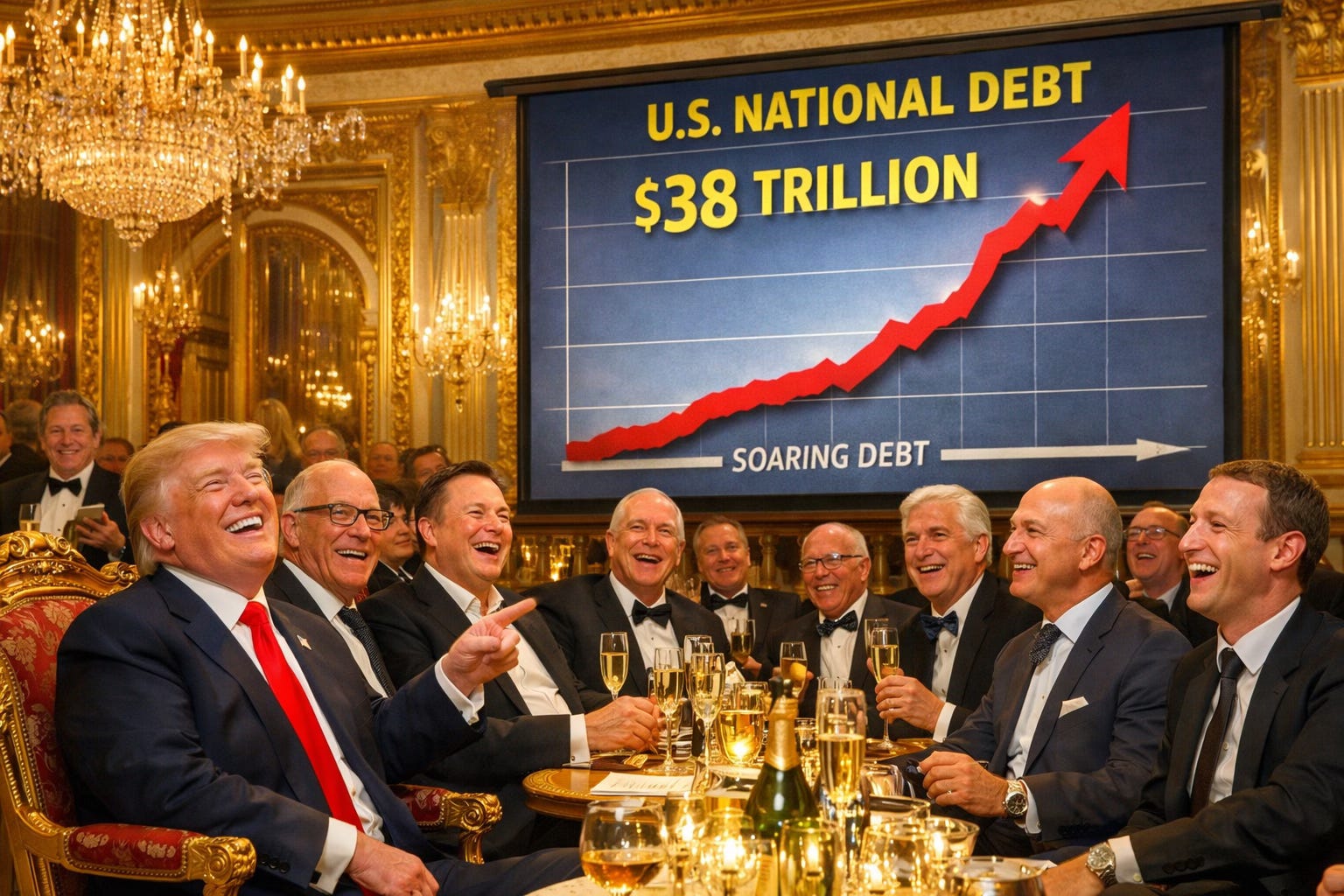
Tonight is the State of the Union speech. If it follows the routine of previous GOP presidencies, Trump will use our national debt as an excuse to call for more tax breaks for billionaires along with drastic cuts to social spending, just like Reagan, Bush, and Bush did.
“The national debt is the United States’ next great war,” Jodey Arrington, the top Republican on the House Budget Committee, thundered this month about our $38 trillion national debt and $1 trillion annual interest payments on that debt.
If we’re going to use his war analogy to describe this very real crisis, the first shots were fired in 1981, when Republicans’ so-called supply-side tax cuts began a forty-five-year upward transfer of over $50 trillion in wealth that made billionaires fabulously rich while it hollowed out our nation’s Treasury. They stole $38 trillion from our government, and another $12 trillion (at least) from working class families via wage freezes and the destruction of unions.
Ever since 1981 — when our national debt was less than a trillion dollars — Republicans have eagerly slashed taxes for their Epstein-class billionaire donors, ballooned deficits, and then cynically blamed teachers, seniors, and working families for the red ink.
Now they warn of catastrophe, but the real catastrophe is the annual payment — now officially a trillion dollars a year in interest — for GOP policies that funneled public wealth upward while starving the middle class.
For forty-five years we were told by Reagan, Bush, Bush, Trump, and their billionaire backers and think tanks that cutting taxes on the morbidly rich and giant corporations would unleash prosperity. Instead, those tax cuts have collectively drained at least $38 trillion out of the federal treasury.
Thirty-eight trillion dollars. That number is so large it barely fits in the human imagination, so let’s translate it:
— Thirty-eight trillion dollars is roughly what it would cost to fund a Medicare-for-All-style universal health care system for a decade. In other words, we could have guaranteed health care as a right in America for ten years — every doctor’s visit, every prescription medication, every surgery and ER visit — and still had money left over. And because it would eliminate the need for Medicare and Medicaid, we could run it for a lot longer than just a decade.
— It’s more than twenty times the entire federal student loan debt that our young people are groaning under. We could have made college free and wiped out every penny of student debt in this country over and over again, freeing tens of millions of Americans to buy homes, start businesses, and raise families instead of mailing checks to banks for decades.
— It’s enough money to build tens of millions of affordable homes. Even at $300,000 per unit — a generous estimate — $38 trillion could pay for well over one hundred million homes. That wouldn’t just reduce housing costs; it would fundamentally reset the housing market and break the back of the affordability crisis that’s crushing the middle class.
— It’s enough to make universal pre-K permanent for generations. And, at the same time, it could have made community college tuition-free nationwide, rebuilt every crumbling bridge, modernized the entire electric grid, gotten us off fossil fuels while it hardened our infrastructure against climate disasters, and still left trillions in the bank for healthcare and education.
Instead, we used that money to lower income and estate taxes on the very wealthiest Americans, and then Republicans turned around and pointed to the resulting debt as proof that we “can’t afford” child care, education, a green economy, health care, or housing.
We also just officially hit a trillion dollars a year just in interest payments on the national debt. That’s money that doesn’t educate a child, doesn’t insure a family, and doesn’t build a single home. It’s simply a transfer to bondholders, the majority of whom are already-wealthy investors and financial institutions.
And what could the $1 trillion a year we’re now paying as interest on the national debt buy instead?
— It could permanently expand Affordable Care Act subsidies and dramatically reduce premiums for millions of working families, and still leave hundreds of billions for other priorities.
— It could fund universal pre-K across America several times over.
— Two years of those interest payments would be enough to eliminate essentially the entire federal student loan portfolio.
— One trillion dollars a year could finance housing construction at a scale not seen since the World War II mobilization, ending both homelessness and skyrocketing rents.
And here’s the cruelest irony: this Republican national debt and its associated interest burden exists solely because of those tax cuts.
The GOP’s “Two Santas” strategy — cut taxes when a Republican is in the White House, then scream about deficits when a Democrat takes over — has produced exactly what its author, Jude Wanniski, wanted it to produce. Gut the middle class while elevating the Epstein-billionaire class into the stratosphere, making them richer than any pharaoh or king in world history.
Contrary to Republican lies demanding we gut social programs to pay down the national debt, we don’t have a “spending problem” in American government: we have a looting problem.
We were told the tax cuts would pay for themselves but, of course, they didn’t because they were never intended to. That was just the GOP’s dishonest sales pitch on behalf of their wealthy owners. Instead, those tax cuts for the rich paid for stock buybacks, wealth concentration, and the rise of a billionaire class that now uses its fortune to buy media, politicians, and Supreme Court judges who ask, “How high?” when billionaires yell, “Jump!”
Thirty-eight trillion dollars isn’t just an accounting number. It’s the health care people didn’t get, the homes that weren’t built, the student debt that shackled a generation, the schools that went underfunded, and the infrastructure that collapsed.
And the trillion dollars a year we now spend on interest is the bill for Reagan’s, Bush’s, Bush’s, and Trump’s forty-five-year “supply side” experiment.
Americans are just now beginning to realize that none of this was ever really about balanced budgets or “fiscal responsibility.” Instead, it was always about power. About spending like drunken sailors to “make the good times roll” during four GOP presidencies, and squealing like stuck pigs when Clinton, Obama, and Biden — who all tried to cut spending and balance the budget, per Wanniski’s plan — were in office.
Deficits were the weapon. Tax cuts were the bait. And the national debt — and thus the middle class — became the hostage. And the result is exactly what you’d expect if you’d designed a system to starve government of revenue while shoveling unimaginable levels of wealth at the top.
Under this 45-year-long GOP punishment of America’s working people, public schools struggled, health care bankrupted families, housing costs exploded, and college became a lifelong mortgage. Meanwhile, the Epstein-billionaire class grew so large and so politically powerful that it now writes and rewrites tax policy, regulatory policy, media ownership, and even the rules of democracy itself.
Supply-side economics — a massive and intentional fraud — was sold as a growth strategy but in reality it was always designed as a wealth transfer strategy that offered Republican presidents the ability to spend like crazy to create the illusion of good economic times. The middle class and the poor paid for it, the debt reflects it, and the trillion dollars a year in today’s interest payments proves it.
This is not some natural economic cycle: it’s the predictable outcome of deliberate Republican policy choices stretching back four decades.
And the question now, as we prepare to hear Trump’s assessment of the state of our union, is simple: do we continue underwriting a system designed to funnel public wealth upward, or do we return to 1933-1980 90%-74% income tax rates on the rich and once again tax the wealthy and corporations so we can pay down our debt and invest some of that money in the working class people who actually created America’s prosperity?
Because that $38 trillion didn’t “disappear”: it was transferred from our treasury straight into the money bins of people like Epstein, Bezos, Zuckerberg, and Musk.
And what we’re living with today is the bill.
The national debt isn’t the cause of our problems: it’s the receipt. It’s the paper trail of the largest upward transfer of wealth in 250 years of American history. And until we name that and tell the truth of how four Republican presidents got us here, we’ll keep paying for it.
Louise’s Daily Song: “The National Debt”
The song that was inspired by this article is here.
My reading this article as an audio podcast is here.
My newest book, The Last American President: A Broken Man, a Corrupt Party, and a World on the Brink is now available in bookstores nationwide.
You can follow me on Blue Sky here: https://bsky.app/profile/thomhartmann.bsky.social
Tax cuts, wars, and lies. Will we survive MORE TRump State of The Unions?
Hopefully next year this f-ing guy will be too busy being impeached to bother to show up. Maybe he will have the bunker under his "ballroom" renovated by then. They can have McDonalds deliver his meals while he watches on C Span and screams at the TV.
Need to stick to the to-do list: Keep protesting, Get out the vote, Impeach, Convict, Celebrate, and Get back to work. We are going to need to show Vance that we are NOT going to put up with his sh*t and the same for the Tech Bros that own him. See you in the streets.
I recently saw a podcast that explains how the national debt isn't like household debt, but politicians pretend it is, so they can make us think there isn't enough money for social programs. "National debt differs from household debt primarily because governments (specifically the U.S.) print their own currency, possess indefinite lifespans, and can raise taxes to service debt, whereas households face finite lifespans, limited income, and cannot create money. National debt acts as a tool for economic growth and is largely held by the public, while household debt is a personal liability"(Baird Wealth).
In our system, if there were no debt, there would be no money because we create money by issuing debt. "Printing money" doesn't cause inflation when there is enough labor and resources to expand the economy. But causing the right amount of inflation keeps us poor enough and exhausted enough not to resist and demand the wealthy pay their fair share. When you pay back a mortgage or car loan with inflated money, it's a good deal because you're paying it off with dollars that aren't worth as much as when you got the loan.
Lenders don't like inflation because they're getting repaid with dollars that are worth less than when they loaned the money.
Raise taxes on the morbidly rich! They're playing us, as Thom explains. It's a big con job. And who is the greatest conman the world has ever seen?