

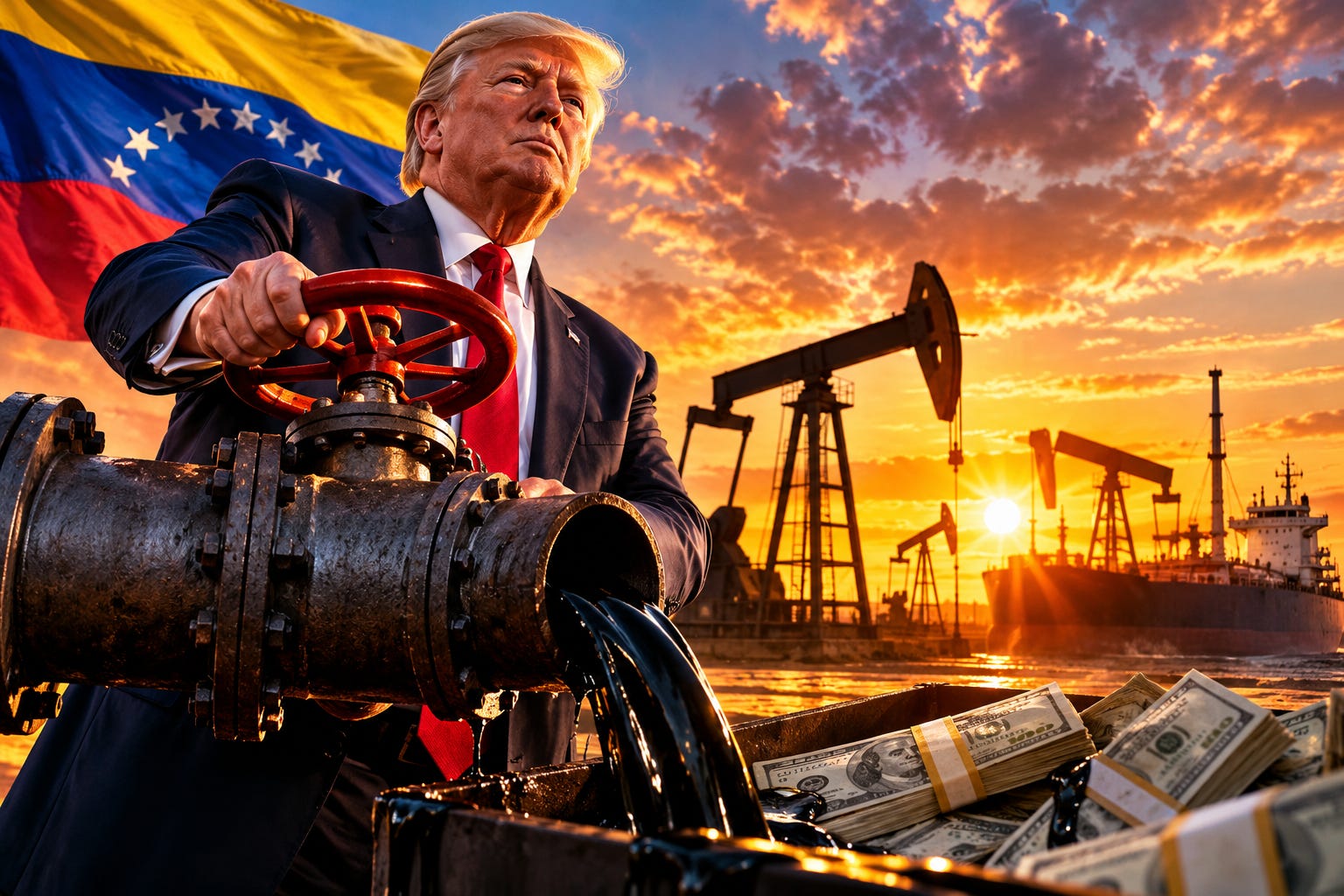
At any other time in American history, it would end the career of somebody like Scott Bessent, our limited-intelligence Treasury Secretary. It came out yesterday when Illinois Congressman Sean Casten was questioning him about the “billions of dollars” that Trump keeps claiming America is “getting” from selling Venezuelan oil.
Bessent agreed with Trump, saying the oil and oil money we’ve seized from that country is “one of the largest assets to ever go on the U.S. balance sheet.” Billions and billions of dollars.
So Casten asked him a simple question: Can you tell us who controls that money and where it is? Can you confirm “whether or not those [funds] are flowing to U.S. persons?”
Bessent’s answer was a shocking single word: “No.” He ain’t talkin…
Did Trump take the oil and the money from the oil? Bessent refuses to say. Trump refuses to say. Nobody, in fact, in the Trump regime will tell us where that money is or who controls it or even who’s making the money accrued on its interest.
Here’s what we do know:
Three days after Trump kidnapped President Maduro and his wife, he went on his Nazi-infested social media site and wrote that Venezuela’s oil revenues would be controlled by him personally “as President of the United States.”
Three days after that, he signed an executive order declaring a “national emergency” involving that oil so no court or creditor could touch the money, screwing the bondholders and oil companies to which Venezuela owed roughly $150 billion.
Then Trump started selling the oil we’d seized from Venezuela. The first load, according to Reuters and Semafor, went to commodity trading companies Vitol and Trafigura for about $500 million, groups that the Washington Post said both carry histories of bribery schemes tied to oil sales.
And that money didn’t go to the Treasury account that was described in Trump’s own executive order. Instead, it went to a bank account in Qatar, right after that country’s leaders gave him a $400 million jet. A senior official explained to Semafor that Qatar was chosen as a “neutral location” where money “can flow freely” without risk of seizure.
Senator Elizabeth Warren was outraged, and told the world what most of us were thinking at the time:
“There is no basis in law for a president to set up an offshore account that he controls so that he can sell assets seized by the American military. That is precisely a move that a corrupt politician would be attracted to.”
In January, Secretary of State Marco Rubio testified to the Senate that $300 million had been sent to Venezuela to cover government payroll needs and another $200 million was “still sitting” in Doha. He referred to the entire operation as “novel” and “a short-term mechanism.”
But a month later, Energy Secretary Chris Wright said on CNBC that the account had been closed and no more money would be flowing to or through Qatar…and nobody has identified where it went, or where it is, since then.
Where’s the money?
House Foreign Affairs committee ranking member Gregory Meeks called it “an offshore slush fund.” Bessent, questioned by Casten back in February refused to say which accounts the Treasury Department was even using, even though Trump’s executive order had named him/Treasury as the custodian for the funds. Casten and Senator Chris Van Hollen again demanded to know where the money was in March, and were again stonewalled. And then again this week.
Meanwhile, the pile of money is growing, particularly given the oil crisis provoked by Trump’s idiotic war against Iran. Using Bloomberg tanker-tracking data, the Council on Foreign Relations published an April estimate that:
“In the first four months of the United States exerting control over Venezuela’s oil exports, almost one hundred million barrels of oil worth an estimated $8 billion have flowed through a process marked by no transparency and minimal oversight.”
A State Department official testified to Congress back in April that around $3 billion had gone back to Venezuela, but Trump boasted in July that the US had sold more than $13 billion in stolen Venezuelan oil and suggested he could divert those funds to the American military or anywhere else he wanted.
Back in June, Marco Rubio tried to assuage Congress’ concerns by saying that accounting firm KPMG “audits every disbursement.” But when the libertarian Reason Magazine dug into it in August they found that neither the agreements nor the audits have been published.
And the so-called “Transparent Sovereignty” website the Venezuelan government set up to show the world its oil transactions only lists one single sale. Apparently, Trump is not even telling them what he’s done with their oil, or where their money went.
And it’s not just oil. In March, Interior Secretary Doug Burgum flew a planeload of American mining executives to Caracas and came home bragging about having made off with over $100 million in gold. He set up a deal to sell it to reportedly bribe-friendly Trafigura with the proceeds going into, well, nobody knows where.
This is an old script that Trump appears to be following here, one many corrupt petrostates pioneered long ago.
For example, in 2014 Nigeria’s central bank governor, Lamido Sanusi, accidentally revealed to his Senate that roughly $20 billion in oil revenue had never made it into the national treasury. President Goodluck Jonathan’s response was to fire him and call the money a “phantom.” When PriceWaterhouseCoopers finally audited the books, it found at least $1.48 billion was simply gone.
I’ve done international relief work in some of the most corrupt nations in the world, been offered bribes and threatened for not taking them, and the pattern I’m seeing here is eerily familiar. They never announce the looting; they just stop letting you know where anything went or who ended up with it. Most people figure that it must be okay since it’s not being reported or discussed, and the conversation dies away.
So, here we are. Trump:
— announced that he’d taken the oil,
— then that he’d taken the money from the sale of the oil and put it in a bank with the country that had given him a free 747 jet,
— hired traders with bribery records,
— refused to publish the contracts,
— put his own hand-picked cabinet members in charge of both the disbursements and oversight, and
— then sent Bessent to Congress to say, “No” when asked if we could please, please know where it’s all gone.
Meanwhile, Republicans in Congress seem to have developed a sudden case of lockjaw.
Congressmen Casten and Joaquin Castro have introduced into the House the Venezuela Oil Proceeds Transparency Act to force the GAO to audit the Qatar account and whatever’s followed it. Republicans refuse to let it out of committee, and Mike Johnson won’t give it a chance on the floor.
This is not how democracies are supposed to work, a message we should all convey to our elected representatives at 202-224-3121.
Pass it along.
Louise’s Daily Song: “Where the Hell is the Money?”
Comments on Tuesday’s Daily Take:
My Republican Dad Fought Fascism, Then Gave Me Kafka. Trump Just Made Me Understand Why
Kafka’s The Trial has always haunted me. Months ago, my oldest son returned from Europe, and Border Patrol officers detained him at the airport for five hours without explanation. They seized his phone and searched the phone’s contents. When he requested an explanation, he was advised only that the reason was on a “need-to-know basis” and claimed no duty to disclose to him the basis for detention.
Your article immediately recalled that terrifying encounter. Thank you, Thom, for reminding us that Due Process is critical in democratic systems.
~ W. A. Lawrence
My mum & I did a tour of East Berlin in 1964. Bricked up windows. Melted tar with broken glass on top of walls, Nobody on the streets. Machine gun towers, guard dogs, huge mirrors on long poles to look under our bus, soldiers examining our passports. When we passed thru Checkpoint Charlie the entire bus breathed a high sigh of relief
~ patti sepich
Read the Article | See all Comments
Get the day’s news, both as a video and written report by Thom Hartmann, as well as a downloadable or an audio podcast, delivered right to your inbox every morning for free at CommonwealthReport.news:

Thom Hartmann’s Well-Read Troublemakers Book Club
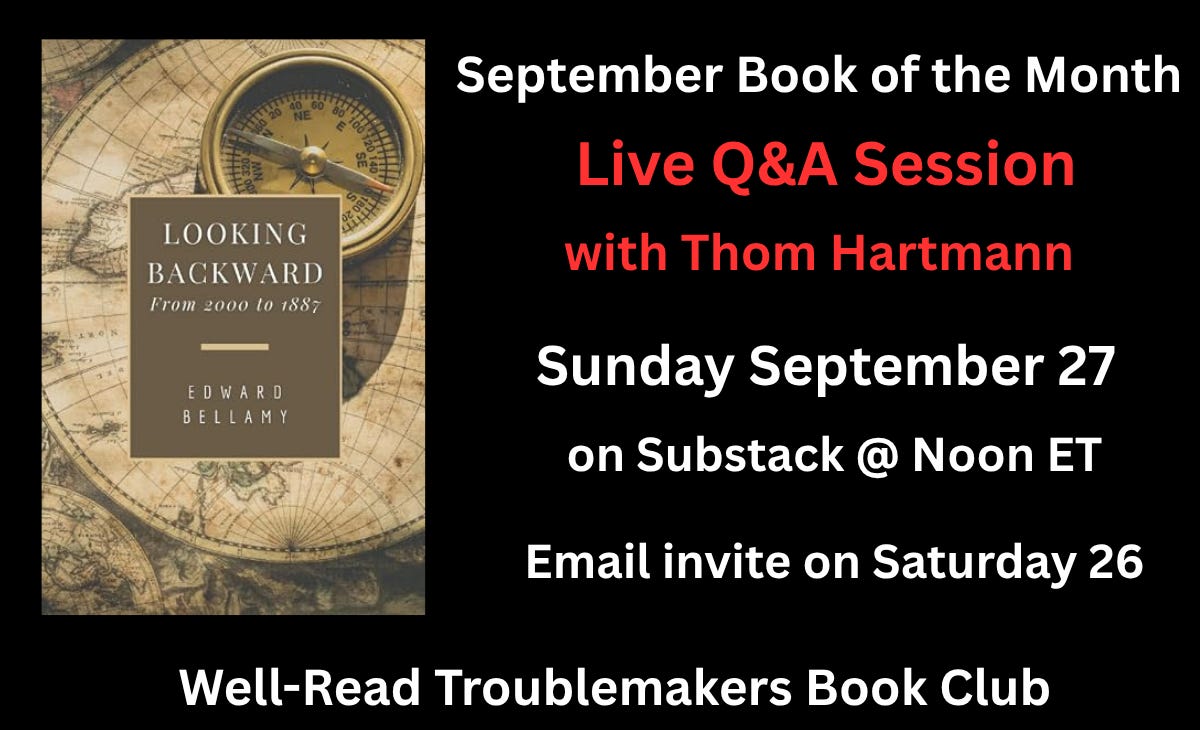
The September book of the month is Looking Backward, From 2000 to 1887, by Edward Bellamy. Buy a copy or download it for free here.
This is a utopian science fiction novel published in 1888. When Julian West falls into a hypnotic sleep in 1887 Boston, he awakens 113 years later to find America transformed into a socialist utopia. Through conversations with his guide, Doctor Leete, West discovers a radically reimagined society where industry is nationalized, goods are equally distributed, and citizens retire at 45. This bestselling novel sparked a political mass movement and inspired over 162 discussion clubs across America.
The whole Trump regime is so evil, it is impossible to find words that adequately describe it, let alone condemn it. They are not only destroying democracy, they are destroying the notion of the nation-state. All wealth and power, in their minds, should reside not in governments in the service of their peoples, but in individuals and families bold enough to just take it. Will civilization survive this era of oil-igopoly? I hope so, but it's a forlorn hope.
So, basically 47 is a War Criminal, a pirate and serial murderer.