

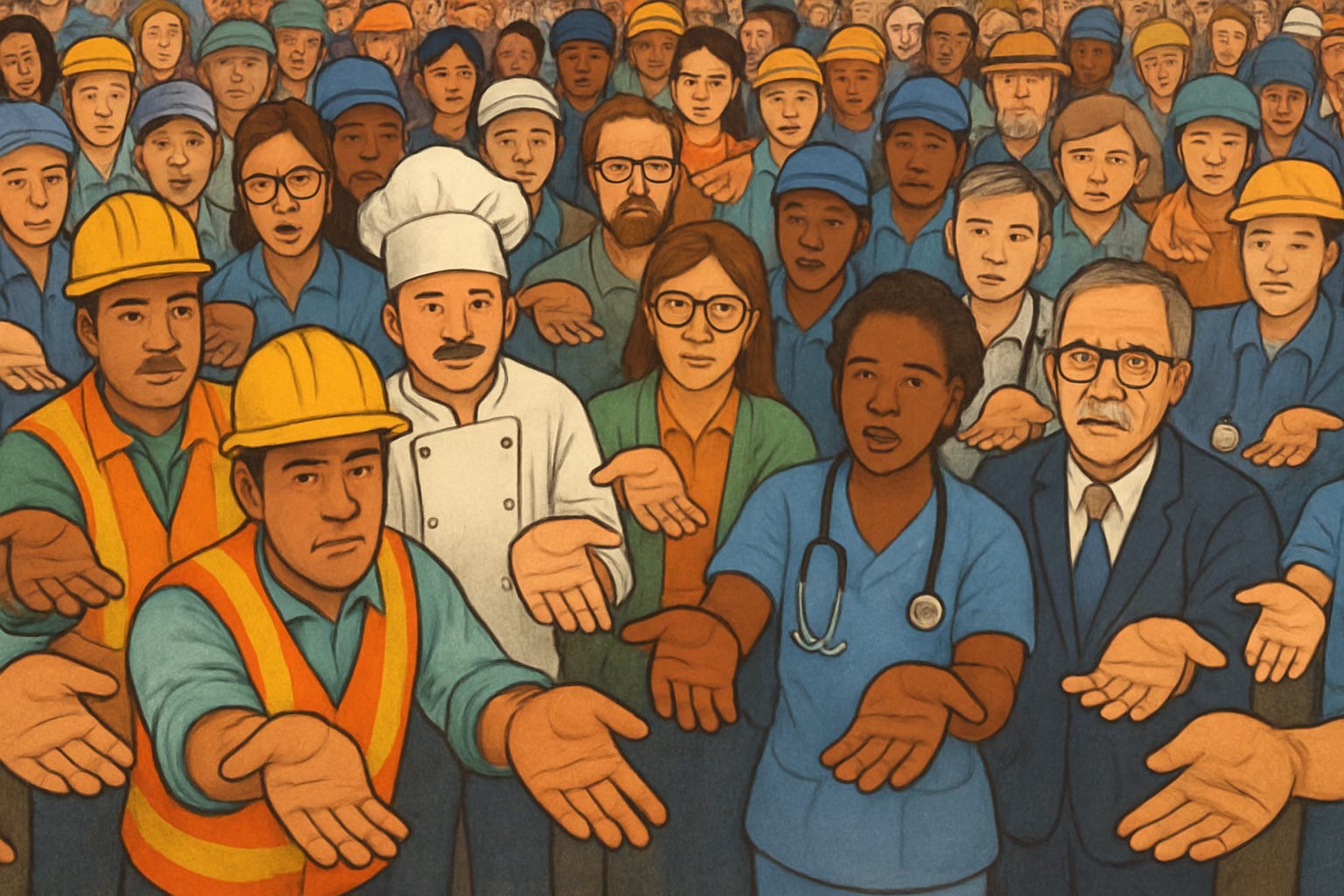
Bob Kennedy, Mehmet Oz, and two Trump administration colleagues recently published an op-ed in The New York Times justifying the GOP’s attempt to cut Medicaid and SNAP benefits by imposing draconian prove-you’re-working paperwork and hoop-jumping requirements on recipients. In their article titled “Trump Leadership: If You Want Welfare and Can Work, You Must,” they noted:
“Our agencies are united in a very straightforward policy approach: Able-bodied adults receiving benefits must work…”
Which raises the question: “Why?”
Why is it that anybody working full time in the richest country in the history of the world should need any sort of government assistance just to eat and stay healthy? Shouldn’t a full-time paycheck — any paycheck for any sort of work — pay enough that people can live a decent life?
As Senate majority leader John Thune said yesterday, “The best health care is a job…” What he failed to note was that that’s true of Denmark but not America.
What, after all, is the point of a minimum wage if not to make sure that people who are working don’t have to steal just to stay alive? Shouldn’t any reasonable capitalist society be organized in such a way that a single full-time worker can raise a family, put their kids through school, take an annual vacation, and have a reasonable retirement?
This is not a new or novel idea.
Among the developed world, the U.S. stands virtually alone in imposing punitive, bureaucratic work requirements for access to food, housing, and health care, all services that are treated as rights in most other wealthy nations.
Welfare in pretty much every other developed country in the world is limited to the disabled, sick, or caregivers because everybody who’s working is making enough to cover their basic living expenses. In Denmark, for example, MacDonalds’ workers earn $22/hour, in addition to getting six weeks of paid vacation, generous pension contributions, overtime pay, and paid sick leave. (And a Big Mac costs ~$5.75 there, compared to $5.69 here.)
This “if you work, you can live a good life” notion isn’t even a new or novel idea for the United States. Progressive Republican President Theodore Roosevelt, a quarter-century before his distant cousin Franklin got a minimum wage passed into law, proposed the same in August, 1912, when he told an audience in Chicago:
“We stand for a living wage. … [It] must include enough to secure the elements of a normal standard of living--a standard high enough to make morality possible, to provide for education and recreation, to care for immature members of the family, to maintain the family during periods of sickness, and to permit of reasonable saving for old age.”
We got close to this during the golden age of America’s middle class, created by FDR’s New Deal programs in the 1933-1980 era, when about a third of Americans had a good union job which formed the wage and benefit floors other employers had to compete with, causing two-thirds of Americans to be able to live a middle class life with a single paycheck.
I saw this myself. When I was five years old, my father sold Rexair vacuum cleaners and World Book Encyclopedias door-to-door; we lived in a garage converted to a one-bedroom house and every month visited what my brothers and I called the “cheese store” (the county-run surplus food facility) to get a free brick of American cheese, a big canvas bag of dried macaroni, and a box of powdered milk.
Then, the next year, dad got a job at a unionized tool-and-die shop. Within a year we’d bought a 3-bedroom house in a new south Lansing suburb and dad had a brand-new car, the first that didn’t have holes in the floorboard. Every year we took a vacation, driving all over the country. We bought our first-ever TV that year, along with a living room full of furniture to sit on to watch it.
In other words, a good job and the Machinists Union lifted my family from poverty into the middle class. And we stayed there: in 2006, dad died in that same house he’d bought brand-new in 1957, which is now occupied by one of my nieces and her family.
By 1980, about a third of all American workers were represented by a union. Between that and the top 74% income tax bracket, America’s middle class grew faster than any had in world history.
Income and wealth were broadly distributed: the average CEO only took, at most, 30 times his employee’s salaries. The top tax rates made it a waste of time to try to take more out of the company, and stock distributions as compensation and corporate stock buybacks were functionally illegal then.
All that changed, of course, with the neoliberal Reagan Revolution of 1981, which led us to the mess we’re in today.
It’s a moral crime that anybody working full time in America must depend on the largess of government or philanthropy to live a decent life: a minimum wage should provide for a minimum standard of living, not a poverty-filled struggle.
A study published by The Journal of the American Medical Association found that states that raised their minimum wage into the $15/hour range (DC, Washington, California, Connecticut, New York, New Jersey, Massachusetts, Maryland, Rhode Island, and Illinois) had welfare participation rates that were about a third lower than states hanging onto the federal $7.25/hour minimum.
In other words, welfare benefits have become subsidies to cheap-labor employers; without those benefits, people couldn’t afford to work for crap wages and employers would be forced by the marketplace itself to pay their workers better.
Back in 2016, the Economic Policy Institute found that raising the minimum wage from $6.75 to $8.00 per hour back in the day in California decreased state public assistance payments by $2.7 billion. It only makes sense.
Thus, the entire GOP effort to impose draconian, paperwork-rich “work requirements” on Medicaid and SNAP recipients boils down to two things:
1. Cheap labor Republicans want us all to pay taxes to subsidize the lifestyles of people whose employers should be paying them enough to live a decent life, and,
2. They want to make it harder and harder for those people who are legitimately in poverty because of disability, age, or a lack of local work opportunities to get benefits so they can reduce federal outlays to fund tax cuts for billionaires.
In other words, it’s all about screwing working people to keep taxes low on billionaires and profits high in corporate America.
So, the next time some billionaire-funded Republican mouthpiece like Kennedy or Oz complains about “able-bodied people on welfare,” don’t just challenge the cruelty — challenge the con.
Ask them why they think the richest nation in the history of the world can’t afford to guarantee that a full-time job comes with a living wage.
Ask why they’re hell-bent on protecting low wages and corporate profits instead of working families.
And then ask the real question: Who benefits when work doesn’t pay — the struggling single mom trying to feed her kids, or the billionaire writing the checks to keep this scam going?
The song that was inspired by this article is here.
My reading this article as an audio podcast is here.
My new book, The Hidden History of the American Dream, is now available.
You can follow me on Blue Sky here.
The website for my radio/TV program is here.
Louise’s Daily Song: “Why Do American Workers Need Welfare?”
Bank executives take home outrageously high pay cheques. However, according to CBS News: "One-third of bank tellers receive some sort of public assistance, ranging from Medicaid to food stamps, the financial industry employee advocacy group found, citing research from the University of California-Berkeley Center for Labor Research and Education.
In New York state, almost 40 percent of bank tellers and their family members are enrolled in public assistance programs, costing the state and federal governments $112 million in benefits." https://www.cbsnews.com/news/one-third-of-bank-tellers-rely-on-public-assistance/
People on SSI, the only federal "welfare" program already live in a fishbowl.
SSI stands for Supplemental Security Income -- administered by the Social Security Administration that provides monthly cash benefits to individuals and families with limited income and resources who are aged, blind, or disabled. The funds are from the budget, not the social security trust funds. SSI a "means-tested" program, as income and resources must be below certain limits to qualify. https://www.ssa.gov/ssi.
Resources include stuff like cash, savings accounts, and certain property, that could be used to meet basic needs. In 2025, the SSI resource limit for an individual is $2,000, and for a couple, it's $3,000. Income limits vary based on factors like the individual's status (student, blind, etc.) and whether they are working.
Many people are eligible for both SSI and Social Security benefits which confuses a lot of people, especially Congressional Republicans. The pitch for the Big Beautiful budget includes removal of fraud and abuse in Medicaid as if the government isn't aready on the case.
Income and resources can vary so that a peron may be eligible one month and not the next. That creates problems with overpayments and underpayments. The process is tiome consuming for SSA employees who could be better allocated to the Ttitle II, retirement and disability program and protect the 3 trillion in trust funds.
When I worked for SSA, the IG and local US attorneys loved to bring charges of fraud, as an object lesson for beneficiaries. Many of the defendats had received SSI on the basis of mental impairments like organic brain syndrome and schizophrenia.
The biggest frausters I knew included our current senator who had to pay the hightst fine in Medicare fraud history and people like
*Philip Esformes: Convicted of a $1.3 billion Medicare and Medicaid fraud scheme, he was freed after serving about 4 1/2 years of a 20-year sentence.
*Salomon Melgen: A Florida eye doctor serving a 17-year sentence for defrauding Medicare out of $42 million through unnecessary procedures, he received a commutation of his sentence.
John Estin Davis: A Tennessee healthcare executive sentenced for over $4.6 million in fraudulent claims to Medicare, he was also granted clemency in the final days of Trump's presidency.
Other individuals who received clemency include:
*Todd Farha, Thaddeus Bereday, William Kale, Paul Behrens, and Peter Clay, former executives of a healthcare maintenance organization convicted of defrauding Medicare or Medicaid.
*Judith Negron, a former owner of a mental health company involved in a $205 million Medicare fraud scheme, whose 35-year sentence was commuted.
* Daniela Gozes-Wagner, who helped falsely bill over $28 million to Medicare and Medicaid.
Paul Walczak, who failed to pay over $10 million in taxes related to nursing homes he controlled.
AI provides: 1. Strengthening Identity Verification:
In-person verification:
Individuals seeking to change direct deposit information or apply for benefits (excluding Medicare, Disability, and SSI) may need to visit a local Social Security office to verify their identity.
Online verification:
The SSA's my Social Security account allows for online identity verification.
New fraud detection system:
The SSA has implemented a new fraud detection system that flags potentially suspicious claims, requiring in-person verification.
2. Penalties for False Statements:
The SSA can impose penalties for knowingly making false or misleading statements or omitting material facts.
Penalties can include fines and even imprisonment.
The SSA will consider all evidence, including any physical, mental, or linguistic limitations, when determining whether to impose a penalty.
3. Fraud Prevention and Reporting:
SSA OIG: The SSA Office of the Inspector General (OIG) investigates and provides recommendations for improving fraud prevention and reporting.
Reporting fraud: You can report suspected fraud to the SSA OIG through their website.
Protect yourself from scams: Be wary of suspicious emails, texts, or phone calls that claim to be from the SSA.
4. Transparency and Accountability:
The SSA is increasing transparency by sharing more information online and making it easier to access services.
The SSA is also working to improve its systems and processes to prevent improper payments.
In essence, the SSA is taking a multifaceted approach to ensure the integrity of SSI benefits. This includes strengthening identity verification, imposing penalties for dishonesty, promoting fraud prevention, and increasing transparency and accountability.